2,2,2-Trifluoroethanol → HCID 86663137, compound
Reaction equation
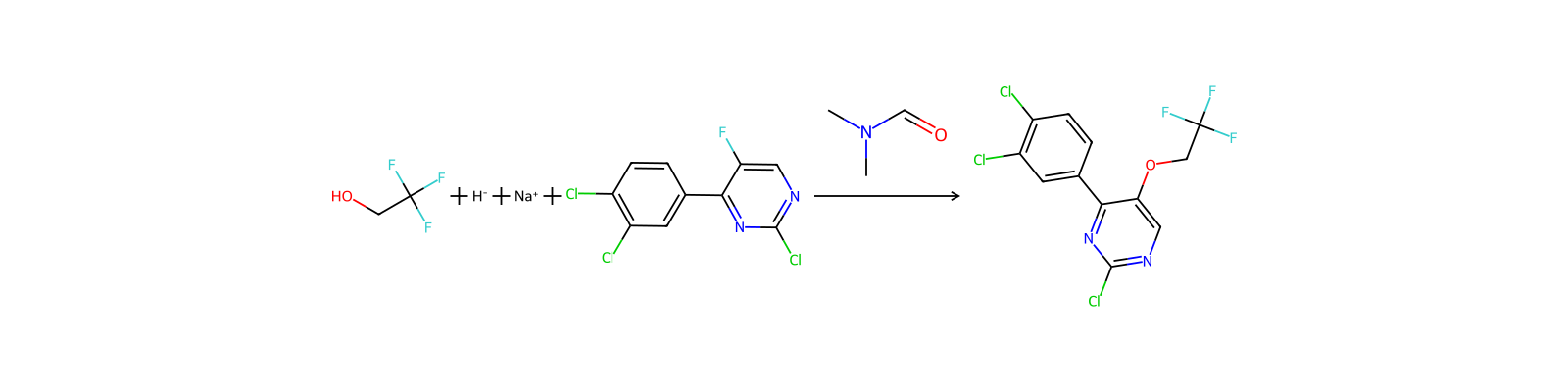
[F:1][C:2]([F:6])([F:5])[CH2:3][OH:4].[H-].[Na+].[Cl:9][C:10]1[N:15]=[C:14]([C:16]2[CH:21]=[CH:20][C:19]([Cl:22])=[C:18]([Cl:23])[CH:17]=2)[C:13](F)=[CH:12][N:11]=1>CN(C=O)C>[Cl:9][C:10]1[N:15]=[C:14]([C:16]2[CH:21]=[CH:20][C:19]([Cl:22])=[C:18]([Cl:23])[CH:17]=2)[C:13]([O:4][CH2:3][C:2]([F:6])([F:5])[F:1])=[CH:12][N:11]=1Participants
5
Reactant 3



Product 1

Reagents, catalysts & solvents 1

Procedure
To a mixture of 2.0 ml 2,2,2-trifluoroethanol in 35 mL dry DMF was added 1.1 g sodium hydride was added and the mixture was stirred at room temperature for 15 minutes. The resulting solution was added drop wise at −10° C. to a solution of 7 g 2-chloro-4-(3,4-dichloro-phenyl)-5-fluoro-pyrimidine in 50 mL dry DMF during 39 min. The reaction mixture was then stirred at room temperature for 2 h. The resulting brown mixture was partitioned between water and ethyl acetate, the phases were separated the organic phase was dried over MgSO4 and purified by chromatography on silica gel with a gradient of heptane:dichloromethane=1:1 to dichloromethane to yield 5.575 g (61.81%) of the title compound as light yellow solid, MS 356.9 (M+H)+.
Workup
- additionwas added
- stirringThe reaction mixture was then stirred at room temperature for 2 h
- customThe resulting brown mixture was partitioned between water and ethyl acetate
- customthe phases were separated the organic phase
- dry with materialwas dried over MgSO4
- custompurified by chromatography on silica gel with a gradient of heptane
Sources & evidence
- ORD record
- ord-22e42c1b3a9a454e90a0a470e386bece
- Source dataset
- uspto-grants-2015_07
- Patent number
- US09090599B2
Reaction notes
Loading…