N-Hydroxyphthalimide → 2-[3-(4-Morpholinyl)propoxy]-1H-isoindole-1,3(2H)-dione
Reaction equation

[O:1]1[CH2:6][CH2:5][N:4]([CH2:7][CH2:8][CH2:9][OH:10])[CH2:3][CH2:2]1.O[N:12]1[C:16](=[O:17])[C:15]2=[CH:18][CH:19]=[CH:20][CH:21]=[C:14]2[C:13]1=[O:22].C1(P(C2C=CC=CC=2)C2C=CC=CC=2)C=CC=CC=1.N(C(OCC)=O)=NC([O-])=O>O1CCCC1>[O:1]1[CH2:6][CH2:5][N:4]([CH2:7][CH2:8][CH2:9][O:10][N:12]2[C:13](=[O:22])[C:14]3=[CH:21][CH:20]=[CH:19][CH:18]=[C:15]3[C:16]2=[O:17])[CH2:3][CH2:2]1Participants
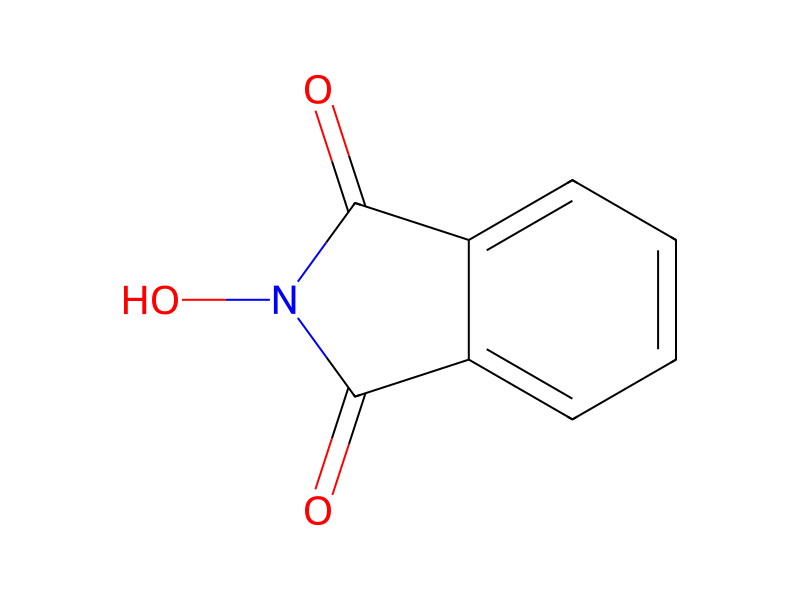




Conditions
- Temperature
- 20 °C
Procedure
N-(3-Morpholinopropoxy)phthalimide may be obtained in the following manner: solution of 3-morpholinopropanol (27.5 g), N-hydroxyphthalimide (30.2 g) and triphenylphosphine (47.2 g) in tetrahydrofuran (400 cc) is cooled to a temperature in the region of 0° C. and ethyl azodicarboxylate (37.65 g) is added in the course of 1 hour 30 minutes. The solution obtained is stirred at a temperature in the region of 20° C. for 18 hours and is then concentrated to dryness under reduced pressure (20 mm Hg; 2.7 kPa) at a temperature in the region of 40° C. The residue is taken up with ethyl acetate (500 cc) and the suspension obtained is filtered. The filtrate is extracted with N aqueous hydrochloric acid solution (200 cc). The aqueous phase is separated after settling has taken place and then extracted 3 times with ethyl acetate (600 cc in total). The aqueous phase is brought to a pH in the region of 10 by adding N aqueous sodium hydroxide solution and is extracted 3 times with ethyl acetate (300 cc in total). The organic extracts are combined, washed 3 times with distilled water (150 cc in total), dried over anhydrous magnesium sulphate, filtered and concentrated to dryness under reduced pressure (20 mm Hg; 2.7 kPa) at a temperature in the region of 40° C. A crude product (25.8 g) is thereby obtained, which is chromatographed on a column 8 cm in diameter containing silica (0.060 mm) (1 kg). The column is eluted with pure ethyl acetate, collecting 500-cc fractions. The first 12 fractions are discarded; the next 48 fractions are combined and concentrated to dryness under reduced pressure (20 mm Hg; 2.7 kPa) at a temperature in the region of 40° C. N-(3-Morpholinopropoxy)phthalimide (15.5 g) is thereby obtained in the form of white crystals, m.p. 98° C. 3-Morpholinopropanol may be obtained according to O. HROMATKA, Ber., 75, 131, (1942).
Workup
- additionis added in the course of 1 hour 30 minutes
- customThe solution obtained
- concentrationis then concentrated to dryness under reduced pressure (20 mm Hg; 2.7 kPa) at a temperature in the region of 40° C
- customthe suspension obtained
- filtrationis filtered
- extractionThe filtrate is extracted with N aqueous hydrochloric acid solution (200 cc)
- customThe aqueous phase is separated after settling
- extractionextracted 3 times with ethyl acetate (600 cc in total)
- additionby adding N aqueous sodium hydroxide solution
- extractionis extracted 3 times with ethyl acetate (300 cc in total)
- washwashed 3 times with distilled water (150 cc in total)
- dry with materialdried over anhydrous magnesium sulphate
- filtrationfiltered
- concentrationconcentrated to dryness under reduced pressure (20 mm Hg; 2.7 kPa) at a temperature in the region of 40° C
- customA crude product (25.8 g) is thereby obtained
- customwhich is chromatographed on a column 8 cm in diameter
- additioncontaining silica (0.060 mm) (1 kg)
- washThe column is eluted with pure ethyl acetate
- customcollecting 500-cc fractions
- concentrationconcentrated to dryness under reduced pressure (20 mm Hg; 2.7 kPa) at a temperature in the region of 40° C
Sources & evidence
- ORD record
- ord-52c5ee1763c84b3897a396a68b7a23af
- Source dataset
- uspto-grants-1992_02
- Patent number
- US05086051
Reaction notes
Loading…