Water → 1-Methoxycarbonyl-4-chloro-3-(3,5-dichlorophenyl)pyrazole
Reaction equation

C(N(CC)CC)C.[Cl:8][C:9]1[C:10]([C:14]2[CH:19]=[C:18]([Cl:20])[CH:17]=[C:16]([Cl:21])[CH:15]=2)=[N:11][NH:12][CH:13]=1.Cl[C:23]([O:25][CH3:26])=[O:24].O>CN(C)C1C=CN=CC=1.C1COCC1>[CH3:26][O:25][C:23]([N:12]1[CH:13]=[C:9]([Cl:8])[C:10]([C:14]2[CH:15]=[C:16]([Cl:21])[CH:17]=[C:18]([Cl:20])[CH:19]=2)=[N:11]1)=[O:24]Participants
7
Reactant 4

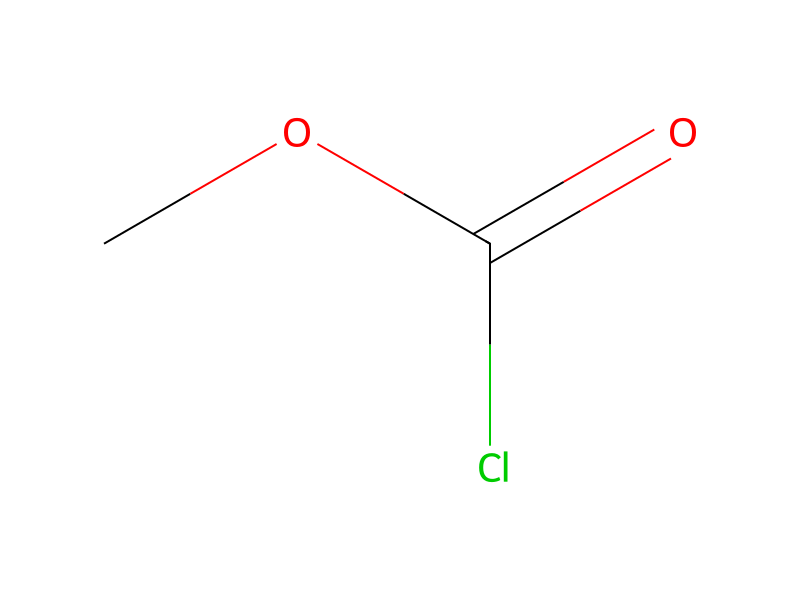


Product 1

Reagents, catalysts & solvents 2


Procedure
2.52 g (0.0204 mol) of 4-dimethylaminopyridine and 18.3 ml (0.132 mol) of triethylamine are added to 30.55 g (0.12 mol) of 4-chloro-3-(3,5-dichlorophenyl)pyrazole dissolved in 300 ml of THF. A solution of 12.5 g (0.132 mol) of methyl chloroformate in 100 ml of THF is run, dropwise and at 0° C., into this solution. Stirring is continued for 20 h at room temperature. The reaction mixture is poured into 500 ml of water and extracted with ethyl acetate. After drying the organic phase and concentration under vacuum, the residue is triturated with 150 ml of heptane, filtered and dried. We obtain 33.5 g of 1-methoxycarbonyl-4-chloro-3-(3,5-dichlorophenyl)pyrazole, melting at 144° C.
Workup
- customat 0° C.
- extractionextracted with ethyl acetate
- customAfter drying
- concentrationthe organic phase and concentration under vacuum
- customthe residue is triturated with 150 ml of heptane
- filtrationfiltered
- customdried
Sources & evidence
- ORD record
- ord-ceef507936c2482a9ec32ee7aa5c9d9e
- Source dataset
- uspto-grants-1999_08
- Patent number
- US05945382
Reaction notes
Loading…