4-Toluenesulfonyl chloride → Ethyl p-methylbenzenesulfonate
Reaction equation

N1([CH2:6][CH2:7][OH:8])C=CN=C1.C(N(CC)CC)C.[S:16](Cl)([C:19]1[CH:25]=[CH:24][C:22]([CH3:23])=[CH:21][CH:20]=1)(=[O:18])=[O:17]>C(Cl)Cl>[C:22]1([CH3:23])[CH:24]=[CH:25][C:19]([S:16]([O:8][CH2:7][CH3:6])(=[O:18])=[O:17])=[CH:20][CH:21]=1Participants
Reactant 3



Product 1
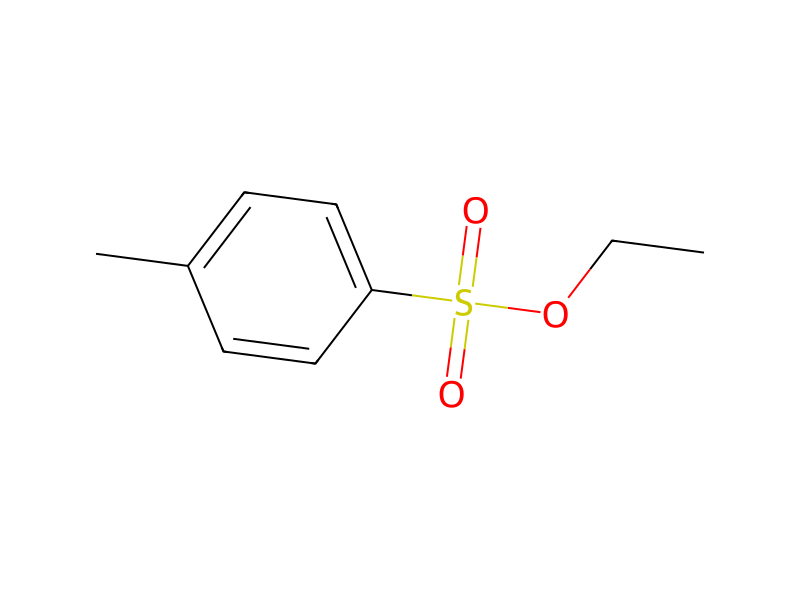
Reagents, catalysts & solvents 1

Procedure
A portion of the crude 2-(imidazol-1-yl)ethanol (10 g, 89 mmol) and triethylamine (10.1 g, 100 mmol) were dissolved in methylene chloride (250 ml), tosyl chloride (17.5 g, 92 mmol) was added over 5 minutes as a solid, giving an exotherm to reflux. The reaction was stirred for 30 minutes at ambient temperature then quenched into 250 ml of 1M hydrogen chloride and 250 ml of methylene chloride. The organic phase was washed with brine and dried by passing it through a phase separator paper. Removal of the solvent by evaporation and purification by flash chromatography using methylene chloride/methanol/ammonia (100/10/1) gave 2-(imidazo]-1-yl)ethyl paratoluene sulphonate (10.95 g, 46%, impure). 4-Hydroxy-5-methoxy-2-nitrobenzamide (3 g, 15.3 mmol), (prepared as described for the starting material in Example 23), and 2-(imidazol-1-yl)ethyl paratoluene sulphonate (7 g, impure) were mixed in the presence of potassium carbonate (5 g, 72 mmol) and anhydrous DMF (20 ml) and heated at 100° C. for 3 hours. The reaction mixture was allowed to cool to ambient temperature and the DMF was removed by evaporation. The residue was resuspended in methylene chloride/methanol/ammnonia (100/10/1) and silica (15 g) was added. The solvent was removed by evaporation and the resulting powder was placed on the top of a silica gel column and eluted using first methylene chloride and slowly increasing the solvent polarity up to methylene chloride/methanol/ammnonia (100/10/1). Removal of the solvent by evaporation gave 4-(2-(imidazol-1-yl)ethoxy)-5-methoxy-2-nitrobenzaride as a cream solid (2.53 g, 55%).
Workup
- customgiving an exotherm
- temperatureto reflux
- customthen quenched into 250 ml of 1M hydrogen chloride and 250 ml of methylene chloride
- washThe organic phase was washed with brine
- customdried
- customRemoval of the solvent
- customby evaporation and purification by flash chromatography
Sources & evidence
- ORD record
- ord-21df2dfcb79240c09c632e9dcf17f657
- Source dataset
- uspto-grants-2001_09
- Patent number
- US06294532B1
Reaction notes
Loading…