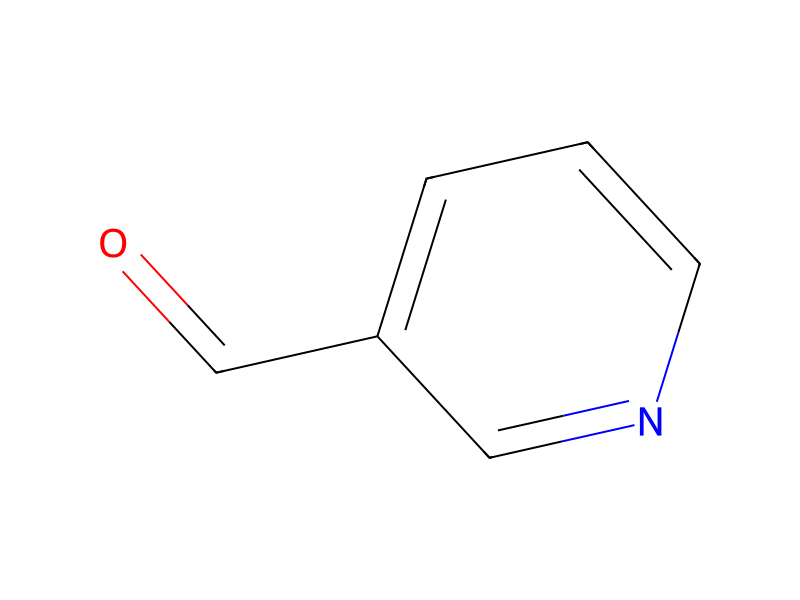
3-Pyridinecarboxaldehyde → HCID 10881145, compound
Reaction equation

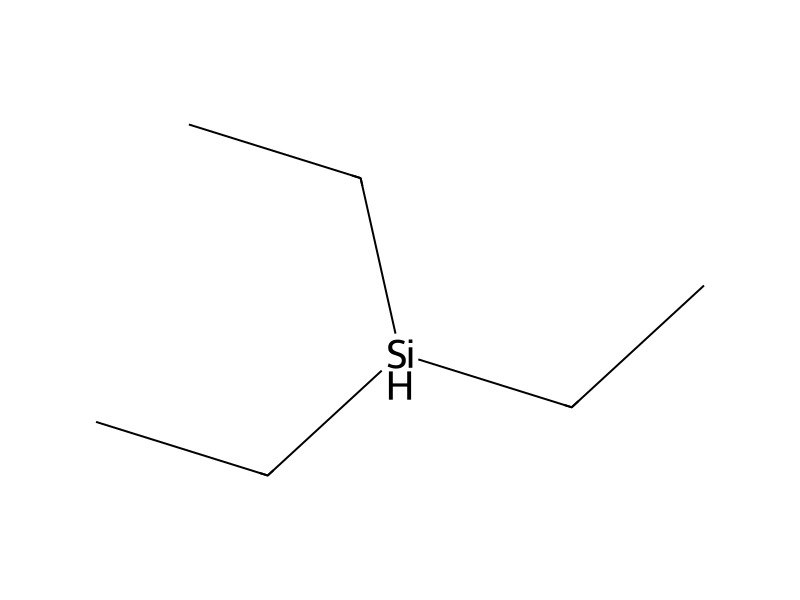
[Br:1][C:2]1[CH:3]=[C:4]2[C:8](=[CH:9][CH:10]=1)[NH:7][C:6]([CH3:11])=[CH:5]2.[N:12]1[CH:17]=[CH:16][CH:15]=[C:14]([CH:18]=O)[CH:13]=1.C([SiH](CC)CC)C>ClCCl.FC(F)(F)C(O)=O>[Br:1][C:2]1[CH:3]=[C:4]2[C:8](=[CH:9][CH:10]=1)[NH:7][C:6]([CH3:11])=[C:5]2[CH2:18][C:14]1[CH:13]=[N:12][CH:17]=[CH:16][CH:15]=1Participants
Reactant 3

Product 1

Reagents, catalysts & solvents 2


Conditions
- Temperature
- 0 °C
Procedure
A solution of 5-bromo-2-methyl-1H-indole (J. Chem. Soc., 1428 (1965)) (2.0 g) and 3-pyridinecarboxaldehyde (1.02 g) in dry dichloromethane (20 ml) was added dropwise over 10 minutes to a stirred solution of triethylsilane(3.30 g) in trifluoroacetic acid (20 ml) at 0° C. The solution was stirred at 0° C. for 30 minutes and then evaporated under vacuum, keeping the temperature below 35° C. The residue was dissolved in dichloromethane, and the solution was washed with 2N sodium hydroxide, water and dried (MgSO4). The solution was evaporated and the residue was chromatographed on silica gel, using dichloromethane/methanol (50:1) as eluent. The product fractions were combined and evaporated, and the residue was crystallised from ether to give the title compound (2.15 g), m.p. 188°-190° C. Found: C,59.62; H,4.43; N,9.26. C15 H13BrN2 requires: C,59.82; H,4.35; N,9.30%.
Workup
- customevaporated under vacuum
- customthe temperature below 35° C
- dissolutionThe residue was dissolved in dichloromethane
- washthe solution was washed with 2N sodium hydroxide, water
- dry with materialdried (MgSO4)
- customThe solution was evaporated
- customthe residue was chromatographed on silica gel
- customevaporated
- customthe residue was crystallised from ether
Sources & evidence
- ORD record
- ord-75f2916e50af49b79d8f15e75eef7ee4
- Source dataset
- uspto-grants-1998_04
- Patent number
- US05744488
Reaction notes
Loading…