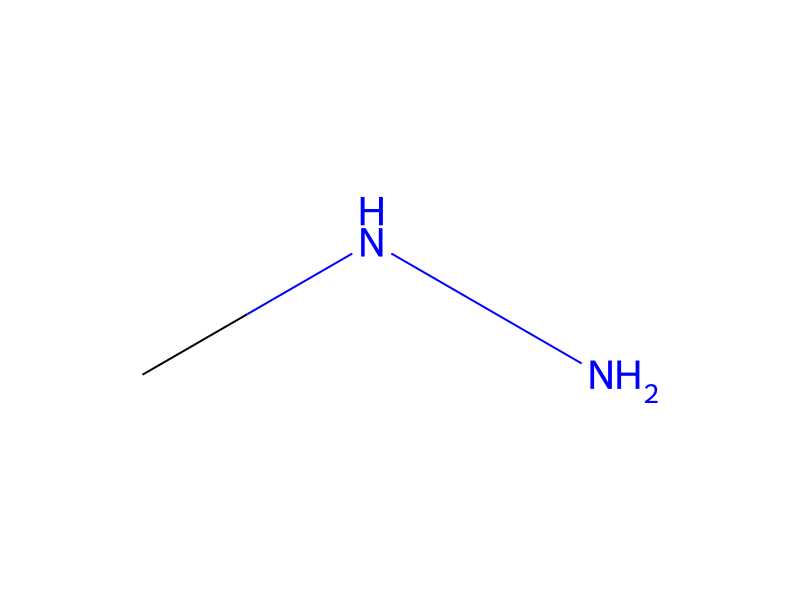
Methylhydrazine → 1H-Pyrazole-5-carboxylic acid, 1-methyl-3-propyl-, ethyl ester
Reaction equation

CC[O-].[Na+].[CH3:5][C:6](=O)[CH2:7][CH2:8][CH3:9].[C:11]([O:18][CH2:19][CH3:20])(=[O:17])[C:12](OCC)=O.[CH3:21][NH:22][NH2:23]>C(O)C.C1(C)C=CC=CC=1.O.C(O)=O>[CH3:21][N:22]1[C:12]([C:11]([O:18][CH2:19][CH3:20])=[O:17])=[CH:5][C:6]([CH2:7][CH2:8][CH3:9])=[N:23]1Participants
Reactant 4



Product 1

Reagents, catalysts & solvents 4




Conditions
- Temperature
- 50 °C
Procedure
340 g of 20% strength by weight sodium ethylate solution in ethanol were initially introduced into a 1 l 4-necked flask and a mixture of 78 g of 2-pentanone and 146.1 g of diethyl oxalate was added dropwise in the course of 1 hour, while stirring. When the addition was complete, 100 ml of ethanol were added and the mixture was subsequently stirred under reflex for a further hour and then cooled to 50° C. During the subsequent stirring time, 41.5 g of methylhydrazine and 50 ml of ethanol were initially introduced into a 1 l 4-necked flask and 41.4 g of formic acid were added dropwise in the course of 15 minutes, with external cooling. The crude ethyl 2,4-diketoheptanecarboxylate enolate solution prepared as described above was now added to this mixture, the solution being kept at 30 to 40° during the addition in order to prevent the enolate salt from crystallizing out. The temperature of the initial mixture was kept between 30 and 35° C. during the addition. The addition had ended after 1 hour. The suspension present became thinner and thinner in the course of the addition of the ester enolate solution. After the mixture had been subsequently stirred at 30° C. for a further hour, 4.5 g of formic acid were added, the mixture was heated and ethanol was distilled off up to a bottom temperature of 110° C. 505 g of ethanol were obtained. The readily stirrable suspension was cooled to room temperature, and 400 ml of water and 200 ml of toluene were added. The organic phase was separated off and the aqueous phase was extracted with 200 ml of toluene. The combined organic phases were washed with 100 ml of water and the toluene was distilled off. The residue (173.1 g--isomer ratio of 4.5:1 of ethyl 1-methyl-3-n-propyl-pyrazole-5-carboxylate to ethyl 1-methyl-5-n-propyl-pyrazole-3-carboxylate), a deep brown oil, was separated into the individual components by fractional distillation. 98 g of the desired product were obtained in a purity of 98.9% by weight (determined by gas chromatography). This corresponds to a yield of 56.2% of theory.
Workup
- additionwas added dropwise in the course of 1 hour
- additionWhen the addition
- stirringthe mixture was subsequently stirred under reflex for a further hour
- additionabove was now added to this mixture
- additionthe solution being kept at 30 to 40° during the addition in order
- customfrom crystallizing out
- additionThe temperature of the initial mixture was kept between 30 and 35° C. during the addition
- additionThe addition
- additionThe suspension present became thinner and thinner in the course of the addition of the ester enolate solution
- stirringAfter the mixture had been subsequently stirred at 30° C. for a further hour
- addition4.5 g of formic acid were added
- temperaturethe mixture was heated
- distillationethanol was distilled off up to a bottom temperature of 110° C
- custom505 g of ethanol were obtained
- temperatureThe readily stirrable suspension was cooled to room temperature
- customThe organic phase was separated off
- extractionthe aqueous phase was extracted with 200 ml of toluene
- washThe combined organic phases were washed with 100 ml of water
- distillationthe toluene was distilled off
- customThe residue (173.1 g--isomer ratio of 4.5:1 of ethyl 1-methyl-3-n-propyl-pyrazole-5-carboxylate to ethyl 1-methyl-5-n-propyl-pyrazole-3-carboxylate), a deep brown oil, was separated into the individual components by fractional distillation
Sources & evidence
- ORD record
- ord-5b33a4215fe54ea7b2fcfff5b78d35cd
- Source dataset
- uspto-grants-1999_11
- Patent number
- US05977378
Reaction notes
Loading…