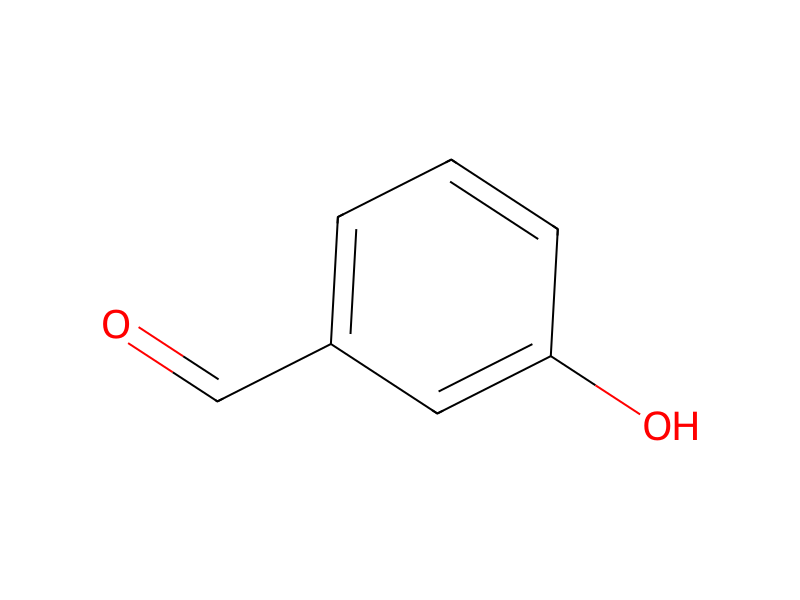
3-Hydroxybenzaldehyde → HCID 10422857, compound
Reaction equation

[OH:1][C:2]1[CH:3]=[C:4]([CH:7]=[CH:8][CH:9]=1)[CH:5]=[O:6].Cl.Cl[CH2:12][C:13]1[CH:22]=[CH:21][C:20]2[C:15](=[CH:16][CH:17]=[CH:18][CH:19]=2)[N:14]=1.C(=O)([O-])[O-].[K+].[K+]>CN(C)C=O>[N:14]1[C:15]2[C:20](=[CH:19][CH:18]=[CH:17][CH:16]=2)[CH:21]=[CH:22][C:13]=1[CH2:12][O:1][C:2]1[CH:3]=[C:4]([CH:7]=[CH:8][CH:9]=1)[CH:5]=[O:6]Participants
5
Reactant 3


Product 1

Reagents, catalysts & solvents 1

Procedure
With stirring, a mixture of 3-hydroxybenzaldehyde (8.5 g), 2-chloromethylquinoline hydrochloride (17 g), and anhydrous potassium carbonate (100 g) in dimethylformamide (200 ml) was heated for 6 hours. After filtration, the solvent was removed with reduced pressure and the residue was partitioned between chloroform and water. The organic layer was dried and concentrated to an oil which upon cooling and treatment withhexane, gave the product as an off-white colored solid (16 g), m.p. 48°-53° C.
Workup
- temperaturewas heated for 6 hours
- filtrationAfter filtration
- customthe solvent was removed with reduced pressure
- customthe residue was partitioned between chloroform and water
- customThe organic layer was dried
- concentrationconcentrated to an oil which
- temperatureupon cooling
Sources & evidence
- ORD record
- ord-c8d768afa9c8408481381c9e97adae88
- Source dataset
- uspto-grants-1989_09
- Patent number
- US04868193
Reaction notes
Loading…