Triphenylphosphine → (2S)-2-(2-borono-4-chlorophenoxy)-propanoic acid
Reaction equation

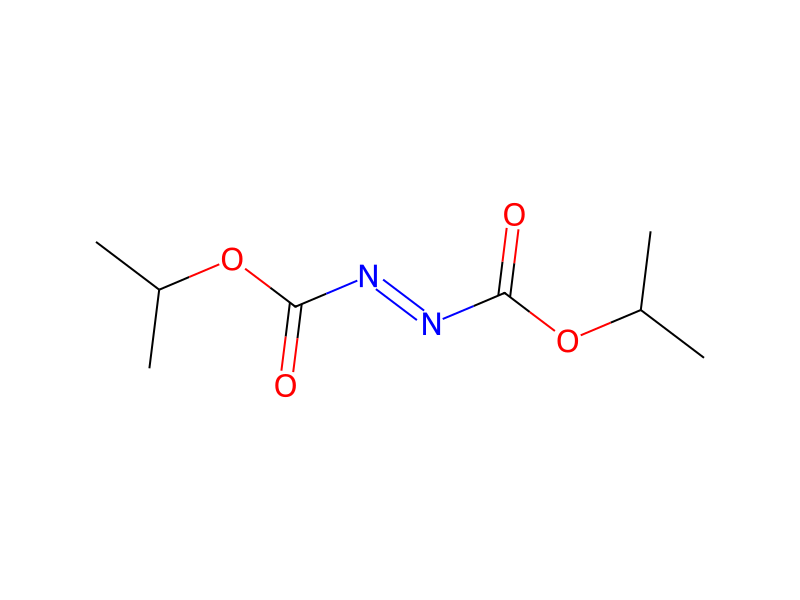
CC(OC(/N=N/C(OC(C)C)=O)=O)C.[Cl:15][C:16]1[CH:21]=[CH:20][C:19]([OH:22])=[C:18]([B:23]2[O:27]C(C)(C)C(C)(C)[O:24]2)[CH:17]=1.C1(P(C2C=CC=CC=2)C2C=CC=CC=2)C=CC=CC=1.[C:51]([O:56]C(C)(C)C)(=[O:55])[C@@H:52]([CH3:54])O>C1COCC1>[B:23]([C:18]1[CH:17]=[C:16]([Cl:15])[CH:21]=[CH:20][C:19]=1[O:22][C@@H:52]([CH3:54])[C:51]([OH:56])=[O:55])([OH:24])[OH:27]Participants
Reactant 4



Product 1

Reagents, catalysts & solvents 1

Procedure
DIAD (3 ml) was added to a mixture of the product from step b) (3.51 g), triphenyl phosphine (3.98 g), tert-butyl (R)-(+) lactate (2.02 g) and THF (80 ml) at 0° C. overnight. The mixture was concentrated in vacuo. The residue was purified by flash column chromatography eluting with isohexane:ethyl acetate (7:3) to give the sub-title compound (4 g). The intermediate obtained was dissolved in acetone and 1M HCl (15 ml) was added, stirred for 20 min, then concentrated in vacuo. Redissolved in dichloromethane (10 ml) and added TFA (5 ml). Stirred for 2 h, then added water (1 ml), stirred for 1 h. The reaction mixture was then diluted (water) and made alkaline by adding dilute NaOH. The organic layer was separated and discarded. The aqueous phase was acidified with concentrated HCl to pH1, then washed with dichloromethane (×2). These organic extracts were dried (MgSO4) then concentrated in vacuo to give the sub-title compound. Yield 1.4 g
Workup
- concentrationThe mixture was concentrated in vacuo
- customThe residue was purified by flash column chromatography
- washeluting with isohexane:ethyl acetate (7:3)
Sources & evidence
- ORD record
- ord-93a7e526e4e0467da92f5a63ff7d99f1
- Source dataset
- uspto-grants-2010_06
- Patent number
- US07737135B2
Reaction notes
Loading…