4-Hydroxybenzaldehyde → 4-[2-(N-Methyl-N-(2-benzoxazolyl)amino)ethoxy]benzaldehyde
Reaction equation

[CH3:1][N:2]([CH2:12][CH2:13][OH:14])[C:3]1[O:4][C:5]2[CH:11]=[CH:10][CH:9]=[CH:8][C:6]=2[N:7]=1.C1(P(C2C=CC=CC=2)C2C=CC=CC=2)C=CC=CC=1.O[C:35]1[CH:42]=[CH:41][C:38]([CH:39]=[O:40])=[CH:37][CH:36]=1.N(C(OCC)=O)=NC(OCC)=O>O1CCCC1>[CH3:1][N:2]([CH2:12][CH2:13][O:14][C:35]1[CH:42]=[CH:41][C:38]([CH:39]=[O:40])=[CH:37][CH:36]=1)[C:3]1[O:4][C:5]2[CH:11]=[CH:10][CH:9]=[CH:8][C:6]=2[N:7]=1Participants
Reactant 4



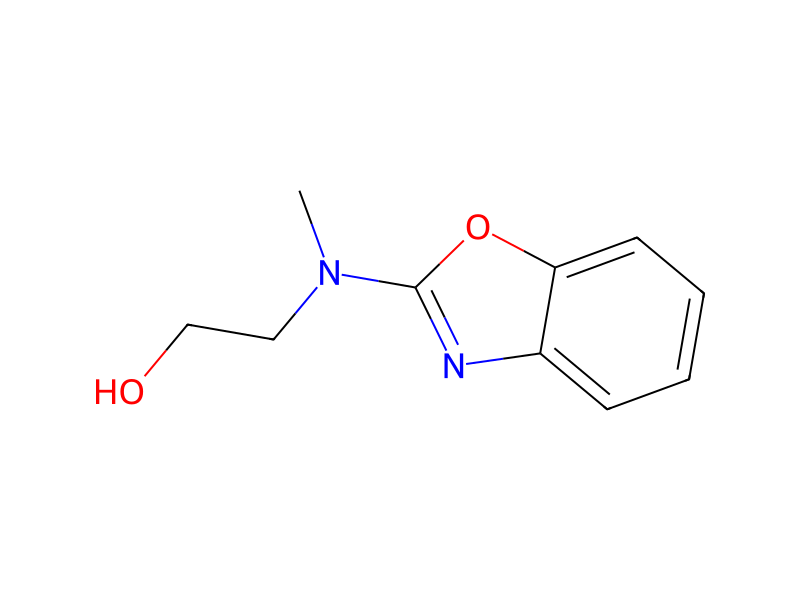
Product 1

Reagents, catalysts & solvents 1

Procedure
To a solution of 2-[N-methyl-N-(2-benzoxazolyl) amino]ethanol (9.6 g), triphenylphosphine (13.1 g) and 4-hydroxybenzaldehyde (6.1 g) in dry tetrahydrofuran (150 ml) was added dropwise a solution of diethyl azodicarboxylate (9.0 g) in dry tetrahydrofuran (30 ml), under a blanket of nitrogen with stirring at room temperature. The solution was stirred overnight at room temperature following which the solvent was removed under reduced pressure. The residue was dissolved in diethyl ether (300 ml), filtered and the ether solution was washed with dilute sodium hydroxide solution (200 ml), saturated brine (200 ml), dried (MgSO4), filtered and the solvent evaporated. The title compound (mp 97°-98° C.) was obtained after chromatography on silica-gel, eluting with dichloromethane.
Workup
- stirringThe solution was stirred overnight at room temperature
- customwas removed under reduced pressure
- dissolutionThe residue was dissolved in diethyl ether (300 ml)
- filtrationfiltered
- washthe ether solution was washed with dilute sodium hydroxide solution (200 ml), saturated brine (200 ml)
- dry with materialdried (MgSO4)
- filtrationfiltered
- customthe solvent evaporated
Sources & evidence
- ORD record
- ord-500d08ba2f884c9f95b19955039b0919
- Source dataset
- uspto-grants-1993_03
- Patent number
- US05194443
Reaction notes
Loading…