Hydrochloric Acid → L-Tyrosine
Reaction equation

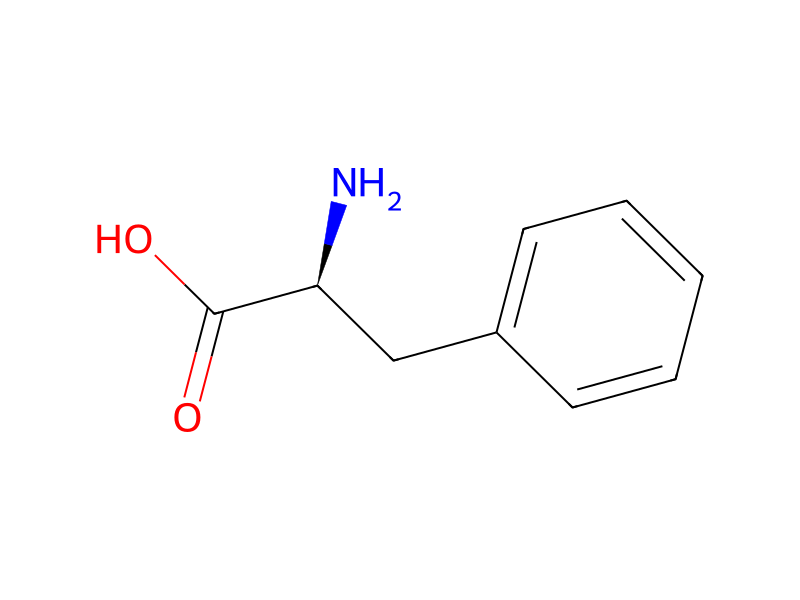
C(O)C(N)(CO)C[OH:4].Cl.[NH2:10][C@H:11]([C:19]([OH:21])=[O:20])[CH2:12][C:13]1[CH:18]=[CH:17][CH:16]=[CH:15][CH:14]=1.N1C2C(=NC=CN=2)C(=O)NC=1N>CC1(C)NC2C(N=C(N)NC=2NC1)=O>[NH2:10][C@H:11]([C:19]([OH:21])=[O:20])[CH2:12][C:13]1[CH:18]=[CH:17][C:16]([OH:4])=[CH:15][CH:14]=1Participants



Procedure
Spectra were taken of the q-6,6-Me2PH2 synthesized enzymatically from 6,6-Me2PH4, and a comparison made with the chemically produced compound. The spectrophotometer was baseline corrected with sample and reference cuvettes containing all of the reaction components (0.1M Tris.HCl, pH 7.4, 4 mM phenylalanine, 2500 units catalase, 0.3 unit phenylalanine hydroxylase) except pterin in a total volume of 0.99 ml. 6,6-Me2PH4 (10 μl of 10 mM) was then added to the sample and distilled H2O (10 μl) to the reference cuvette. Scanning was begun immediately and spectra taken at 2 minute intervals. The formation of q-6,6-Me2PH2 was complete within 4 minutes. After correction for tyrosine formed and phenylalanine consumed, the spectrum was within 3% of that produced by Br2 oxidation of 6,6-Me2PH4 (FIGURE).
Workup
- additioncontaining all
- distillationdistilled H2O (10 μl) to the reference cuvette
- waitThe formation of q-6,6-Me2PH2 was complete within 4 minutes
Sources & evidence
- ORD record
- ord-06bd25cffca448bfa81b97fdf17642cb
- Source dataset
- uspto-grants-1993_03
- Patent number
- US05196533
Reaction notes
Loading…