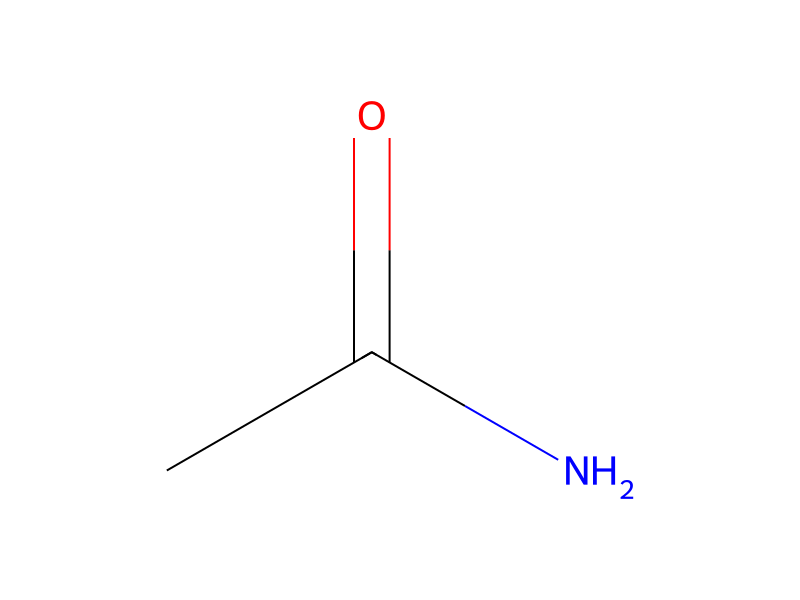
Acetamide → Ethyl 2,4-dimethyl-1,3-oxazole-5-carboxylate
Reaction equation

[C:1]([NH2:4])(=[O:3])[CH3:2].[CH2:5]([O:7][C:8](=[O:14])[CH2:9][C:10]([CH2:12]Cl)=O)[CH3:6].C(=O)([O-])O.[Na+].Cl>C(O)(=O)C>[CH3:2][C:1]1[O:3][C:9]([C:8]([O:7][CH2:5][CH3:6])=[O:14])=[C:10]([CH3:12])[N:4]=1Participants
Reactant 4



Product 1

Reagents, catalysts & solvents 1

Procedure
800 mmol of acetoamide and 400 mmol of ethylchloroaceto acetate were dissolved into 146 g of anhydrous acetic acid. Reaction was carried out for 10 hours at 130° C. The reacted liquid was alkalized with saturated sodium hydrogen carbonate and then the product was extracted into an organic phase using ethyl acetate. The organic phase was dried under sodium sulfate and then the solvent was evaporated out, obtaining a black liquid. To this black liquid 6N hydrochloric acid aqueous solution was added to make it alkaline. Then the product was extracted into organic phase using ethyl acetate. The thus obtained solid substance was dissolved in hexane. Insoluble matter was eliminated and solvent was evaporated out, obtaining ethyl 2,4-dimethyl-1,3-oxazole-5-carboxylate, an yellowish white solid (yield: 30%).
Workup
- customReaction
- extractionthe product was extracted into an organic phase
- customThe organic phase was dried under sodium sulfate
- customthe solvent was evaporated out
- customobtaining a black liquid
- extractionThen the product was extracted into organic phase
- dissolutionThe thus obtained solid substance was dissolved in hexane
- customsolvent was evaporated out
Sources & evidence
- ORD record
- ord-bfe287ac4b3b45a5ae023297950183de
- Source dataset
- uspto-grants-2014_07
- Patent number
- US08779086B2
Reaction notes
Loading…