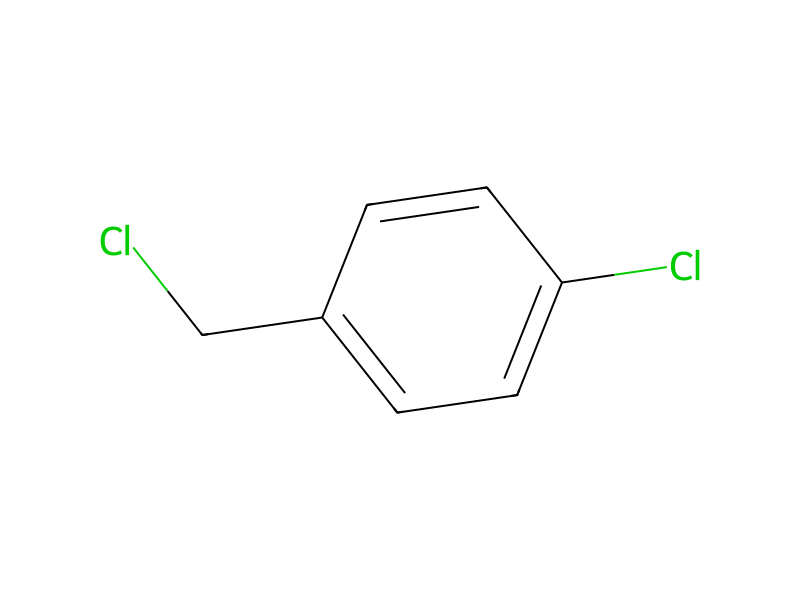
1-Chloro-4-(chloromethyl)benzene → HCID 14423765, compound
Reaction equation

[H-].[Na+].[O:3]=[C:4]1[NH:13][C:12](=[O:14])[C:11]2[C:6](=[CH:7][CH:8]=[CH:9][CH:10]=2)[N:5]1[CH2:15][C:16]([O:18][CH2:19][CH3:20])=[O:17].[Cl:21][C:22]1[CH:29]=[CH:28][C:25]([CH2:26]Cl)=[CH:24][CH:23]=1>CN(C)C=O.C(OCC)(=O)C>[Cl:21][C:22]1[CH:29]=[CH:28][C:25]([CH2:26][N:13]2[C:12](=[O:14])[C:11]3[C:6](=[CH:7][CH:8]=[CH:9][CH:10]=3)[N:5]([CH2:15][C:16]([O:18][CH2:19][CH3:20])=[O:17])[C:4]2=[O:3])=[CH:24][CH:23]=1Participants





Procedure
To a suspension of sodium hydride (60% in mineral oil, 367 mg) in N,N-dimethylformamide (15 ml) was added a solution of ethyl 2-(1,2,3,4-tetrahydro-2,4-dioxoquinazolin-1-yl)acetate (2.0 g) in N,N-dimethylformamide (35 ml) with stirring at room temperature under nitrogen atmosphere, and the mixture was stirred at the same temperature for 15 minutes. To this mixture was added 4-chlorobenzyl chloride (1.48 g) with stirring at room temperature and the mixture was stirred at the same temperature for 1 hour. The solvent was evaporated in vacuo to give a residue, which was dissolved in ethyl acetate. The ethyl acetate solution was washed with water and dried. Evaporation of the solvent gave a residue, which was washed with n-hexane to afford ethyl 2-[3-(4-chlorobenzyl)-1,2,3,4-tetrahydro-2,4-dioxoquinazolin-1-yl]acetate (2.55 g).
Workup
- stirringthe mixture was stirred at the same temperature for 15 minutes
- stirringwith stirring at room temperature
- stirringthe mixture was stirred at the same temperature for 1 hour
- customThe solvent was evaporated in vacuo
- customto give a residue, which
- washThe ethyl acetate solution was washed with water
- customdried
- customEvaporation of the solvent
- customgave a residue, which
- washwas washed with n-hexane
Sources & evidence
- ORD record
- ord-f8346277088444c1964fb59bebac03e5
- Source dataset
- uspto-grants-1989_11
- Patent number
- US04883800
Reaction notes
Loading…