2-Chloro-N,N-dimethylethylamine → 11-Amino-4,5-dihydro-2-(2-dimethylaminoethyl)-2H-pyrazolo [3,4-a]acridine
Reaction equation

[NH2:1][C:2]1[C:3]2[C:8]([N:9]=[C:10]3[C:15]=1[C:14]1[NH:16][N:17]=[CH:18][C:13]=1[CH2:12][CH2:11]3)=[CH:7][CH:6]=[CH:5][CH:4]=2.[H-].[Na+].[CH3:21][N:22]([CH3:26])[CH2:23][CH2:24]Cl>CN(C=O)C>[NH2:1][C:2]1[C:3]2[C:8]([N:9]=[C:10]3[C:15]=1[C:14]1=[N:16][N:17]([CH2:24][CH2:23][N:22]([CH3:26])[CH3:21])[CH:18]=[C:13]1[CH2:12][CH2:11]3)=[CH:7][CH:6]=[CH:5][CH:4]=2Participants
5



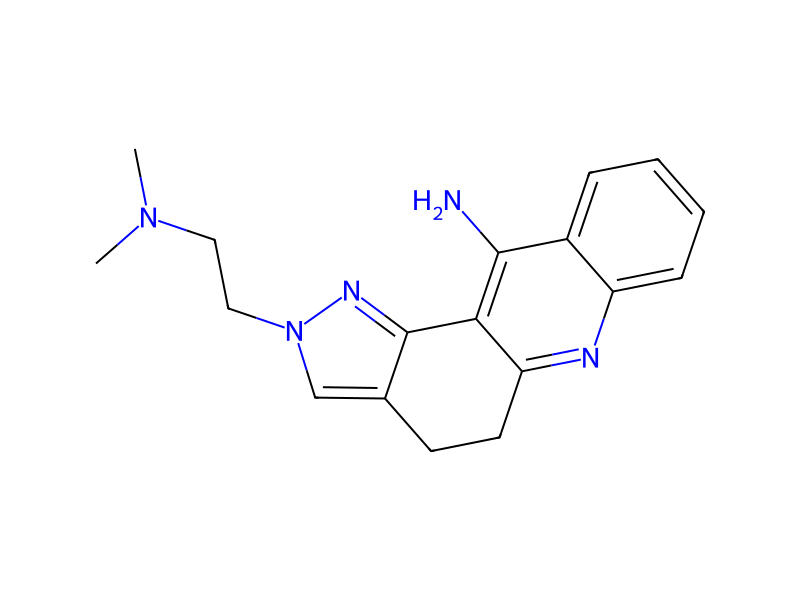

Procedure
To a solution of 11-amino-4,5-dihydro-1H-pyrazolo[3,4-a]acridine (8.0 g) in dry DMF (240 ml) was slowly added NaH (60%)(1.69 g). The reaction was stirred at room temperature for one hour, 2-dimethylaminoethylchloride (4.64 g) was added and stirring was continued for two hours. An additional 4.64 g of 2-dimethylaminoethylchloride was added and the reaction was stirred at room temperature overnight.
Workup
- stirringstirring
- waitwas continued for two hours
- stirringthe reaction was stirred at room temperature overnight
Sources & evidence
- ORD record
- ord-c69472532dfe476c8d3c61294b38eff5
- Source dataset
- uspto-grants-1993_01
- Patent number
- US05179100
Reaction notes
Loading…