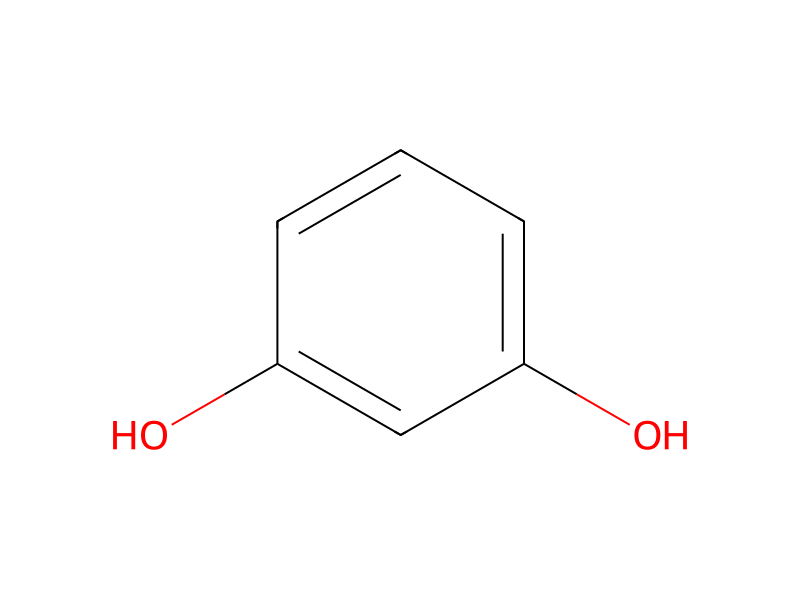
Resorcinol → HCID 86747847, compound
Reaction equation

[CH3:1][N:2]1[C:15]2[C:10](=[CH:11][CH:12]=[CH:13][CH:14]=2)[C:9](=[O:16])[C:8]2[C:7](Cl)=[C:6]([Cl:18])[CH:5]=[C:4]([Cl:19])[C:3]1=2.[C:20]1([CH:27]=[CH:26][CH:25]=[C:23](O)[CH:22]=1)[OH:21].C(=O)([O-])[O-].[K+].[K+].CN1C(=O)CCC1>O.O1CCCC1.C1(C)C=CC=CC=1>[Cl:18][C:6]1[CH:5]=[C:4]([Cl:19])[C:3]2[N:2]([CH3:1])[C:15]3[C:10](=[CH:11][CH:12]=[CH:13][CH:14]=3)[C:9](=[O:16])[C:8]=2[C:7]=1[C:23]1[CH:25]=[CH:26][CH:27]=[C:20]([OH:21])[CH:22]=1Participants
6
Reactant 4



Product 1

Reagents, catalysts & solvents 1

Procedure
8 g (25.6 mmol) of N-methyl-1,2,4-trichloroacridone, 8.46 g (76.8 mmol) of resorcinol, 14.15 g (102.4 mmol) of potassium carbonate and 80 ml of NMP are stirred at 60° C. for 30 hours. The mixture is discharged into water/tetrahydrofuran/toluene. The organic phase is washed with water, dried over sodium sulfate, filtered through silica gel and evaporated. The residue is chromatographed on silica gel using methylene chloride. The fractions containing the product are evaporated, and the residue is recrystallized from 0-dichlorobbenzene: Yield 5.45 g (55%), melting point 220°-222° C.
Workup
- washThe organic phase is washed with water
- dry with materialdried over sodium sulfate
- filtrationfiltered through silica gel
- customevaporated
- customThe residue is chromatographed on silica gel
- additionThe fractions containing the product
- customare evaporated
- customthe residue is recrystallized from 0-dichlorobbenzene: Yield 5.45 g (55%), melting point 220°-222° C.
Sources & evidence
- ORD record
- ord-b29aa5a305cc458f95cada7b5b5a8043
- Source dataset
- uspto-grants-1995_07
- Patent number
- US05432049
Reaction notes
Loading…