Trifluoromethanesulfonic acid → 1,1'-(1,1,1,3,3,3-Hexafluoropropane-2,2-diyl)dibenzene
Reaction equation

N[C:2]1[CH:7]=[CH:6][C:5]([C:8]([C:17]2[CH:22]=[CH:21][C:20](N)=[CH:19][CH:18]=2)([C:13]([F:16])([F:15])[F:14])[C:9]([F:12])([F:11])[F:10])=[CH:4][CH:3]=1.NC1C=C(C(C2C=CC=C(N)C=2)(C(F)(F)F)C(F)(F)F)C=CC=1.OC1C=CC(C(C2C=CC(O)=CC=2)(C(F)(F)F)C(F)(F)F)=CC=1.FC(F)(F)S(OS(C(F)(F)F)(=O)=O)(=O)=O.FC(F)(F)S(O)(=O)=O>[Pd].C(N(CC)CC)C>[C:17]1([C:8]([C:5]2[CH:6]=[CH:7][CH:2]=[CH:3][CH:4]=2)([C:9]([F:10])([F:11])[F:12])[C:13]([F:14])([F:15])[F:16])[CH:18]=[CH:19][CH:20]=[CH:21][CH:22]=1Participants
Reactant 5
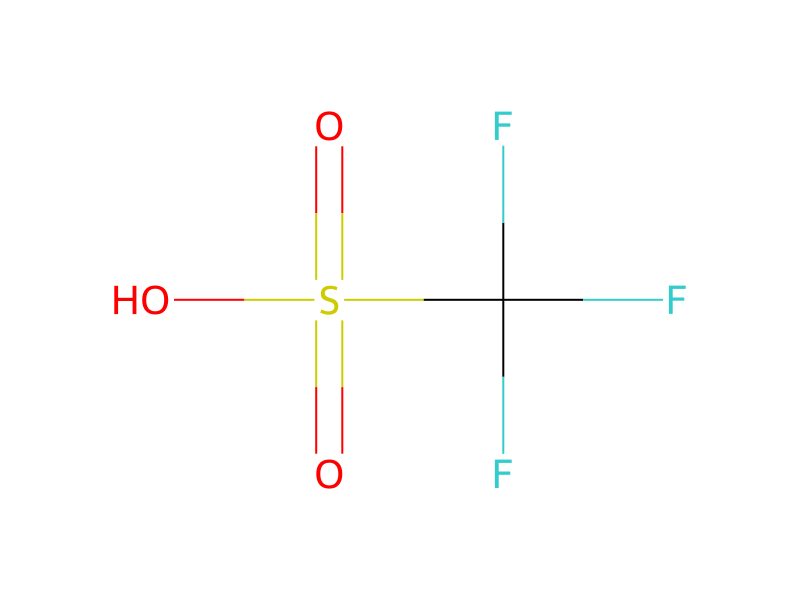


Product 1

Reagents, catalysts & solvents 2


Procedure
On the other hand, a process is described in the literature (K. S. Y. Lau et al., Journal of Polymer Science, Polymer Chemistry Edition, 20. 2381-2393 (1982)) which facilitates the preparation of an isomeric diamine to 2,2-bis-(4-aminophenyl) hexafluoropropane from, 2,2-bis-(3-aminophenyl)hexafluoropropane, in very high yields. For this, the process also starts out from 2,2-bis-(4-hydroxyphenyl)hexafluoropropane, the hydroxyl groups of which are converted into F3C-SO3 groups by reaction with trifluoromethanesulfonic anhydride. Trifluoromethanesulfonic acid is eliminated from this compound in a second step by catalytic hydrogenation with a palladium/charcoal catalyst which is suspended in triethylamine and 2,2-bisphenylhexafluoropropane is thus obtained. This compound is nitrated using nitric acid in concentrated sulfuric acid to give 2,2-bis-(3-nitrophenyl)hexafluoropropane in a third step which is then hydrogenated on a palladium/charcoal catalyst to give 2,2-bis-(3-aminophenyl)hexafluoropropane in a fourth step.
Sources & evidence
- ORD record
- ord-de511b885028461595b8e6c600a45f75
- Source dataset
- uspto-grants-1990_05
- Patent number
- US04922019
Reaction notes
Loading…