N-methyl-2-pyrrolidone → 2-Chloro-6-methoxy-4-methylquinazoline
Reaction equation

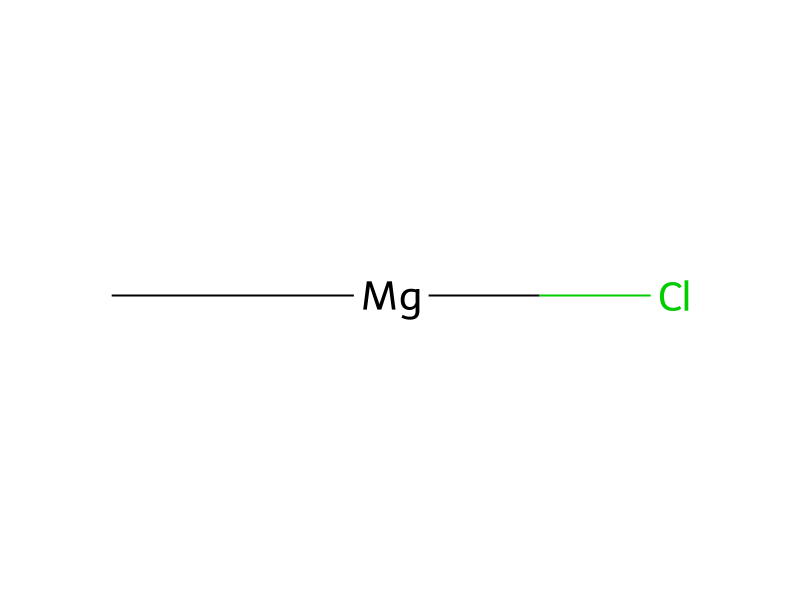
[Cl:1][C:2]1[N:11]=[C:10](Cl)[C:9]2[C:4](=[CH:5][CH:6]=[C:7]([O:13][CH3:14])[CH:8]=2)[N:3]=1.[CH3:15]N1CCCC1=O.C[Mg]Cl.[Cl-].[NH4+]>C1COCC1.C/C(/[O-])=C/C(C)=O.C/C(/[O-])=C/C(C)=O.C/C(/[O-])=C/C(C)=O.[Fe+3]>[Cl:1][C:2]1[N:11]=[C:10]([CH3:15])[C:9]2[C:4](=[CH:5][CH:6]=[C:7]([O:13][CH3:14])[CH:8]=2)[N:3]=1Participants
7
Reactant 4



Product 1

Reagents, catalysts & solvents 2


Procedure
To a mixed solution of 2,4-dichloro-6-methoxyquinazoline (CAS.105763-77-7) (0.15 g), iron(III) acetyl acetonate (0.023 g), N-methyl-2-pyrrolidinone (0.4 mL), and THF (8 mL) was added a solution (0.22 mL) of 3 M methyl magnesium chloride in THF at room temperature, and the mixture was stirred for 12 h. The reaction mixture was added dropwise to a mixture of ice (30 g) and ammonium chloride (0.3 g), and then the aqueous layer was extracted with chloroform. The organic layer was concentrated under reduced pressure, and the residue was purified by silica gel column chromatography (silica gel, chloroform) and crystallized with diisopropyl ether to obtain 2-chloro-6-methoxy-4-methylquinazoline (0.08 g).
Workup
- extractionthe aqueous layer was extracted with chloroform
- concentrationThe organic layer was concentrated under reduced pressure
- customthe residue was purified by silica gel column chromatography (silica gel, chloroform)
- customcrystallized with diisopropyl ether
Sources & evidence
- ORD record
- ord-c3823bd771b54c7b9bdaaff9c8c25b50
- Source dataset
- uspto-grants-2011_10
- Patent number
- US08044068B2
Reaction notes
Loading…