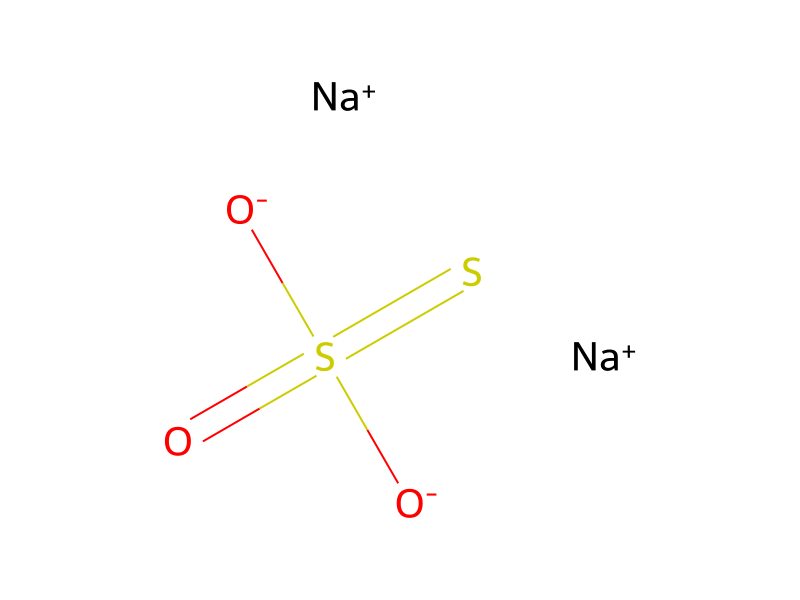
Sodium Thiosulfate → HCID 15645294, compound
Reaction equation

C1(S[C:8]2[CH:9]=[C:10]([CH:14]3[O:18][CH2:17][CH2:16][O:15]3)[CH:11]=[CH:12][CH:13]=2)C=CC=CC=1.Cl[C:20]1[CH:25]=[CH:24][CH:23]=[C:22](C(OO)=O)[CH:21]=1.[S:30]([O-:34])([O-])(=[O:32])=S.[Na+].[Na+].C(=O)(O)[O-].[Na+]>ClCCl>[C:20]1([S:30]([C:12]2[CH:11]=[C:10]([CH:14]3[O:15][CH2:16][CH2:17][O:18]3)[CH:9]=[CH:8][CH:13]=2)(=[O:34])=[O:32])[CH:25]=[CH:24][CH:23]=[CH:22][CH:21]=1Participants
6
Reactant 4



Product 1

Reagents, catalysts & solvents 1

Conditions
- Temperature
- -78 °C
Procedure
Combine 2-(3-phenylsulfanylphenyl)-[1,3]-dioxolane (1.0 g, 3.6 mmol) and dichloromethane (15 ml). Cool to about −78° C. Add a slurry of m-chloroperbenzoic acid (2.3 g, 7.2 mmol) in dichloromethane (10 ml). After 30 minutes, warm to room temperature then add a solution 1N of sodium thiosulfate (20 ml). After 15 minutes, add a solution of saturated sodium bicarbonate. Separate the organic layer and extract the aqueous layer with dichloromethane, combine the organic layers and wash sequentially with distilled water and brine and then dry (Na2SO4), filter, and concentrate to give a residue. Chromatograph the residue eluting with EtOAc to give the title compound.
Workup
- temperaturewarm to room temperature
- waitAfter 15 minutes
- customSeparate the organic layer
- extractionextract the aqueous layer with dichloromethane
- washwash sequentially with distilled water and brine
- dry with materialdry (Na2SO4)
- filtrationfilter
- concentrationconcentrate
- customto give a residue
- washChromatograph the residue eluting with EtOAc
Sources & evidence
- ORD record
- ord-01fb8923aad14bac9abaed58127052fb
- Source dataset
- uspto-grants-2011_10
- Patent number
- US08044090B2
Reaction notes
Loading…