Benzaldehyde → 2-Phenylethanol
Reaction equation

[C:1]1([CH2:7][CH:8]=[O:9])[CH:6]=[CH:5][CH:4]=[CH:3][CH:2]=1.C(C1C=CC=CC=1)(=O)C.C(=O)C1C=CC=CC=1.[H][H]>[Ni].[Mo].C1(C)C=CC=CC=1>[CH:4]1[CH:5]=[CH:6][C:1]([CH2:7][CH2:8][OH:9])=[CH:2][CH:3]=1Participants
Reactant 4

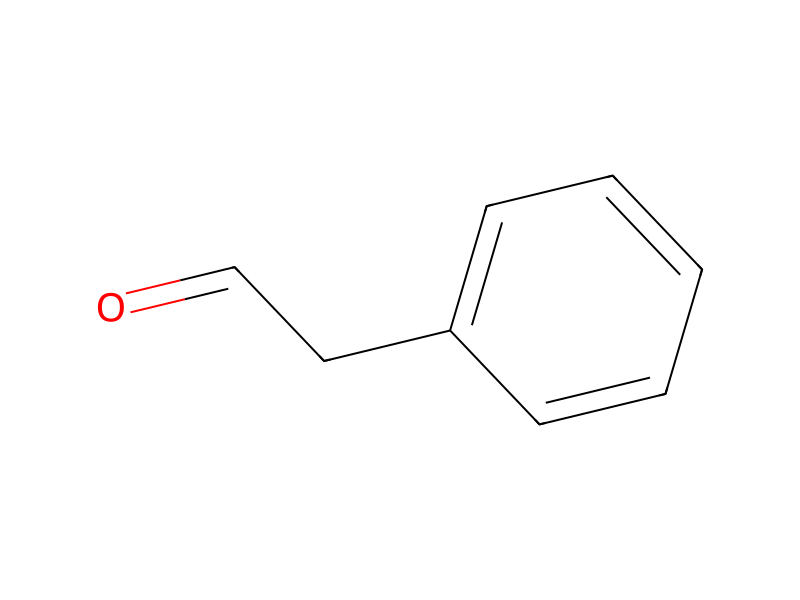


Product 1
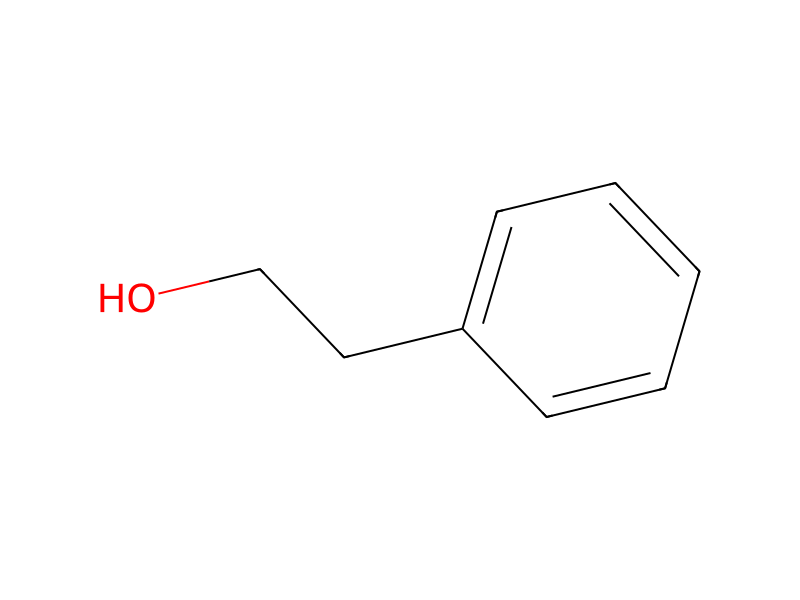
Reagents, catalysts & solvents 3



Procedure
The toluene layers (about 4.7 l) were collected and the toluene was evaporated under reduced pressure. The residual liquid was fed to a fractionating column under reduced pressure. Thus, the remaining toluene was at first evaporated, then styrene (35 g) was recovered at 35° C./10 mmHg and fractional distillation was further conducted at 100° to 110° C. (bath temperature) to obtain a distillate (73 g) boiling at 45° to 50° C./2 mmHg. This distillate was found to be a mixture of phenylacetaldehyde (78 wt.%), acetophenone (19 wt.%) and benzaldehyde (3 wt.%) according to gas chromatographic analysis. The thus obtained mixture, 100 ml of toluene and 5 g of Raney nickel catalyst modified with molybdenum (Mo/Ni=6/94 atomic ratio) were fed into an autoclave of 500 ml capacity equipped with a magnetic stirrer, and hydrogenation was carried out at room temperature under 500 atm. of hydrogen pressure for 20 hours. After the reaction, the catalyst was filtered off from the reaction mixture. The filtrate was evaporated to remove the toluene by a rotary evaporator. The remaining liquid was subjected to fractional distillation under reduced pressure of 10 mmHg, whereby benzyl alcohol (1.8 g) boiling at 75° C./10 mmHg, α-phenethyl alcohol (13.1 g) boiling at 87° C./10 mmHg and β-phenethyl alcohol (53.8 g) boiling at 97° C./10 mmHg were obtained. Thus-obtained β-phenethyl alcohol had a refraction index nD20 =1.533 and no halogen according to halogen-detective test and showed no other peaks on the gas chromatogram.
Workup
- customThe toluene layers (about 4.7 l) were collected
- customthe toluene was evaporated under reduced pressure
- customstyrene (35 g) was recovered at 35° C./
- distillation10 mmHg and fractional distillation
- customwas further conducted at 100° to 110° C.
- customto obtain a distillate (73 g) boiling at 45° to 50° C./2 mmHg
- customequipped with a magnetic stirrer
- customAfter the reaction
- filtrationthe catalyst was filtered off from the reaction mixture
- customThe filtrate was evaporated
- customto remove the toluene
- customby a rotary evaporator
- distillationThe remaining liquid was subjected to fractional distillation under reduced pressure of 10 mmHg, whereby benzyl alcohol (1.8 g) boiling at 75° C./10 mmHg, α-phenethyl alcohol (13.1 g) boiling at 87° C./10 mmHg
Sources & evidence
- ORD record
- ord-c43b8dbcba2a4dfbabc31e70aee1fe4a
- Source dataset
- uspto-grants-1981_06
- Patent number
- US04271320
Reaction notes
Loading…