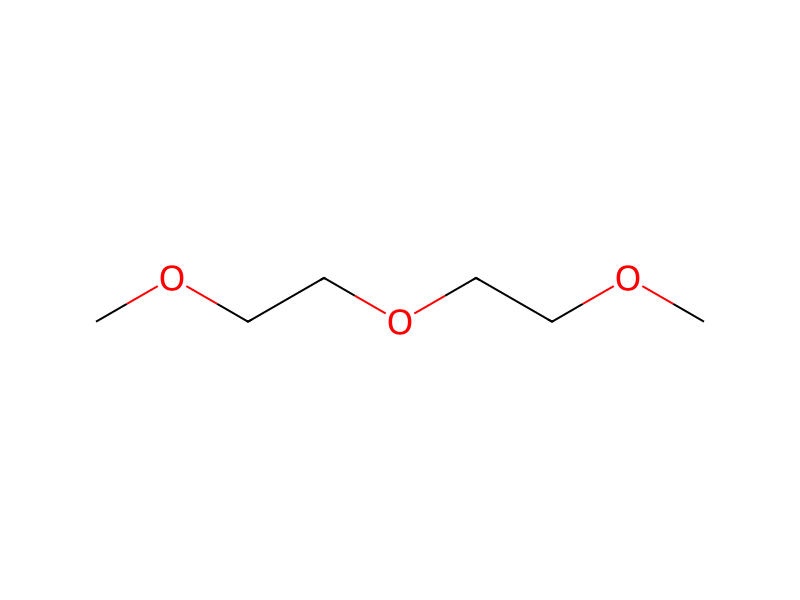
Diglyme → HCID 23455911, compound
Reaction equation

[F:1][C:2]([F:10])([F:9])[C:3]([C:5]([F:8])([F:7])[F:6])=[O:4].[F-:11].[K+].COCCOCCOC.Cl[C:23]([F:30])([F:29])[C:24]([Cl:28])=[C:25]([F:27])[F:26]>O>[F:11][C:3]([O:4][C:23]([F:30])([F:29])[C:24]([Cl:28])=[C:25]([F:27])[F:26])([C:5]([F:8])([F:7])[F:6])[C:2]([F:10])([F:9])[F:1]Participants
Reactant 4



Product 1

Reagents, catalysts & solvents 1

Procedure
Hexafluoroacetone (16.6 g, 0.10 mol) was distilled into a stirred mixture of potassium fluoride (5.80 g, 0.10 mol) and 1-(2-methoxyethoxy)-2-methoxyethane (hereinafter referred to as diglyme) (100 ml) to give a homogeneous solution. This mixture was maintained at 25°-30° C. and treated with 1,2-dichloro-1,1,3,3,-tetrafluoropropene (18.3 g, 0.10 mol, prepared according to J. E. Bissey, H. Goldwhite and D. G. Rowsell, J. Org. Chem., 32, 1542 (1967)). The mixture was stirred overnight and then it was poured into water (500 ml). The lower layer was washed with water (250 ml), dried, and distilled to give 1-(heptafluoro-2-propoxy)-1,1,3,3-tetrafluoro-2-chloropropene (13.0 g, 0.039 mol, 39%), bp 82°-83° C. whose structure was confirmed by the following: λmax 5.72 (CCl=CF2) and 7.5-10 μm (CF, C-O); 19F NMR, -64.9 (m) 2F, -- OCF2C=C; -76.0 (2nd order m) 2F, C=CF2 ; -81.2 (t J=5.7 Hz, each member d J=2.2 Hz) 6F, CF3 ; and -146.7 ppm (t J=22.9 Hz each member septet J=2.2 Hz) 1F, CFO.
Workup
- customto give a homogeneous solution
- temperatureThis mixture was maintained at 25°-30° C.
- washThe lower layer was washed with water (250 ml)
- customdried
- distillationdistilled
Sources & evidence
- ORD record
- ord-389d71c3164644acb12a27f58ec09faf
- Source dataset
- uspto-grants-1981_06
- Patent number
- US04275225
Reaction notes
Loading…