Butyric anhydride → HCID 86190388, compound
Reaction equation

[C:1](OC(=O)C)(=[O:3])C.C(OC(=O)CC)(=O)CC.C(OC(=O)CCC)(=O)CCC.C1(=O)OC(=O)CC1.C1(=O)OC(=O)CCC1.C1(=O)OC(=O)CCCC1.[C:52]([F:59])([F:58])([F:57])[C:53](Cl)([Cl:55])[F:54]>[Zn]>[C:52]([C:53]([CH2:1][OH:3])([F:54])[Cl:55])([F:59])([F:58])[F:57]Participants
Reactant 7
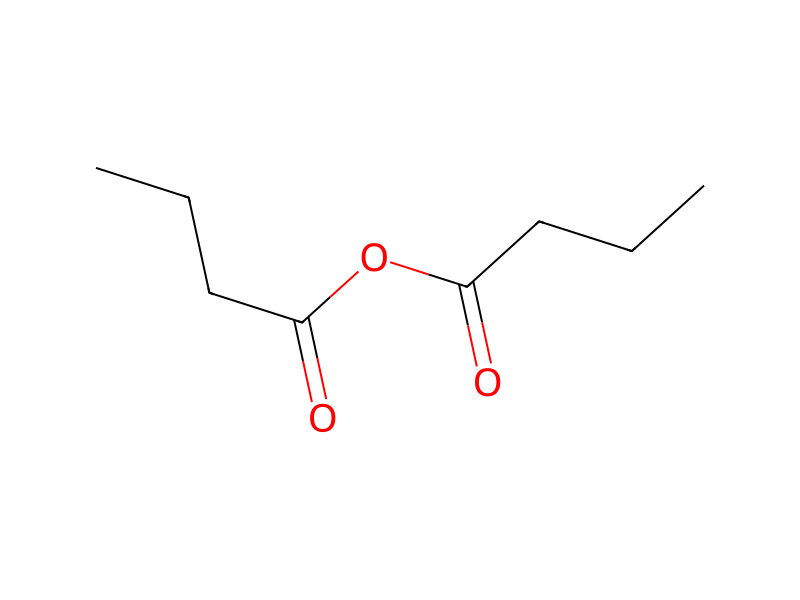



Product 1

Reagents, catalysts & solvents 1

Procedure
This reaction may be run as described with addition of both reagents in the same reaction vessel or the acid anyhydride may be added alone to produce CF3CClFCH2OC(═O)CH3, which may be isolated. And then the reactive metal may be added to the CF3CClFCH2OC(═O)CH3 to produce the HFO-1234yf. In this process the carboxylic acid anhydride is selected from the group consisting of acetic anhydride, propionic anhydride, butyric anhydride, succinic anhydride, glutaric anhydride, and adipic anhydride. The reactive metal powder is as described previously herein. The reductive dehydroxychlorination can be done without neutralizing the product mixture from the reaction of CFC-114a with zinc and an aldehyde. Or the reductive dehydroxychlorination may be done after first isolating the CF3CClFCH2OH, and then esterification by reaction with a carboxylic acid anhydride and a reactive metal to form CF3CClFCH2OC(═O)CH3. Any of these dehydroxychlorinations produce Composition C as described above.
Sources & evidence
- ORD record
- ord-7c9a026e32e54a3e9115cf49c4da8ec7
- Source dataset
- uspto-grants-2012_04
- Patent number
- US08147710B2
Reaction notes
Loading…