Water → 2-(3,3-Difluoroazetidin-1-yl)-5-nitropyridine
Reaction equation

Cl.[F:2][C:3]1([F:7])[CH2:6][NH:5][CH2:4]1.Cl[C:9]1[CH:14]=[CH:13][C:12]([N+:15]([O-:17])=[O:16])=[CH:11][N:10]=1.C(N(CC)CC)C.O>CN(C)C=O.C(OCC)(=O)C>[F:2][C:3]1([F:7])[CH2:6][N:5]([C:9]2[CH:14]=[CH:13][C:12]([N+:15]([O-:17])=[O:16])=[CH:11][N:10]=2)[CH2:4]1Participants
7



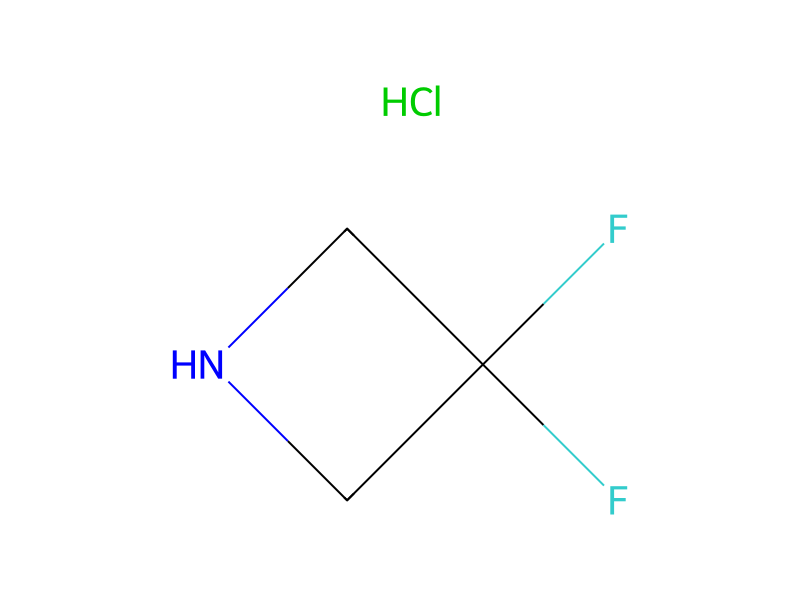



Conditions
- Temperature
- 100 °C
Procedure
A mixture of 0.367 g (2.84 mmol) of 3,3-difluoroazetidine hydrochloride, 0.3 g (1.89 mmol) of 2-chloro-5-nitropyridine and 0.41 mL (2.84 mmol) of triethylamine in 10 mL of dimethylformamide is heated overnight at 100° C. After this time, the suspension is poured into a mixture of 30 mL of water and 30 mL of ethyl acetate. The aqueous phase is separated, and then extracted with 20 mL of ethyl acetate. The organic phases are combined, washed three times with 25 mL of water, then dried over sodium sulfate and concentrated at reduced pressure. The resultant product is purified by chromatography on a silica column, eluting with dichloromethane. We thus obtain 0.34 g of the expected product in the form of a yellow solid.
Workup
- customThe aqueous phase is separated
- extractionextracted with 20 mL of ethyl acetate
- washwashed three times with 25 mL of water
- dry with materialdried over sodium sulfate
- concentrationconcentrated at reduced pressure
- customThe resultant product is purified by chromatography on a silica column
- washeluting with dichloromethane
Sources & evidence
- ORD record
- ord-f52be86ad057407ba5cd929767a456c9
- Source dataset
- uspto-grants-2012_04
- Patent number
- US08153650B2
Reaction notes
Loading…