Bromobenzene → 4-Benzyl-1-phenylpiperazin-2-one
Reaction equation

Br[C:2]1[CH:7]=[CH:6][CH:5]=[CH:4][CH:3]=1.[CH2:8]([N:15]1[CH2:20][CH2:19][NH:18][C:17](=[O:21])[CH2:16]1)[C:9]1[CH:14]=[CH:13][CH:12]=[CH:11][CH:10]=1.C(=O)([O-])[O-].[K+].[K+]>[Cu]I>[CH2:8]([N:15]1[CH2:20][CH2:19][N:18]([C:2]2[CH:7]=[CH:6][CH:5]=[CH:4][CH:3]=2)[C:17](=[O:21])[CH2:16]1)[C:9]1[CH:10]=[CH:11][CH:12]=[CH:13][CH:14]=1Participants
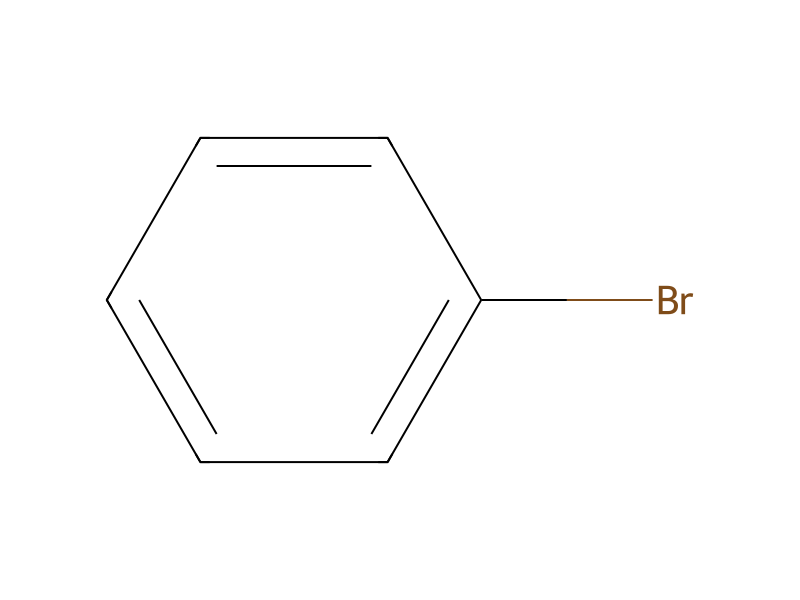




Conditions
- Temperature
- 220 °C
Procedure
To a 25 ml, microwave vessel was added 4-bromobenzene (6.1 g, 39.0 mmol), 4-benzylpiperazin-2-one (5.0 g, 36.3 mmol), potassium carbonate (3.6 g, 26.3 mmol), and copper(I) iodide (500 mg, 2.6 mmol). The reaction vessel was sealed and purged with nitrogen. Anhydrous NMP (8.0 mL) was added via syringe. The vessel was heated via microwave at 220° C. for 40 minutes. The mixture was filtered through a bed of celite followed by CH2Cl2 (20 mL). The filtrate was purified via silica gel chromatography using 2% MeOH in CH2Cl2 to obtain the desired piperazinone as a white solid (3.4 g, 12.7 mmol, 50% yield). 1H NMR (400 MHz, CDCl3) δ 7.42-7.24 (m, 10H), 3.69 (t, J=5.4 Hz, 1H), 3.63 (s, 1H), 3.40-3.31 (m, 2H), 2.84 (s, 1H), 2.81 (t, J=5.2 Hz, 1H). LC/MS (10%-99% CH3CN (0.035% TFA)/H2O (0.05% TFA)), m/z: M+1 obs=267.3; tR=1.63 min.
Workup
- customThe reaction vessel was sealed
- custompurged with nitrogen
- additionAnhydrous NMP (8.0 mL) was added via syringe
- filtrationThe mixture was filtered through a bed of celite
- customThe filtrate was purified via silica gel chromatography
Sources & evidence
- ORD record
- ord-b72e5d2a679c47c5b0568e197227c8ad
- Source dataset
- uspto-grants-2012_04
- Patent number
- US08163720B2
Reaction notes
Loading…