Potassium Carbonate → 1-Bromo-4-[(cyclopropylmethyl)thio]benzene
Reaction equation

[Br:1][C:2]1[CH:7]=[CH:6][C:5]([SH:8])=[CH:4][CH:3]=1.[CH:9]1([CH2:12]Br)[CH2:11][CH2:10]1.C(=O)([O-])[O-].[K+].[K+]>CN(C=O)C.O>[CH:9]1([CH2:12][S:8][C:5]2[CH:6]=[CH:7][C:2]([Br:1])=[CH:3][CH:4]=2)[CH2:11][CH2:10]1Participants
Reactant 3


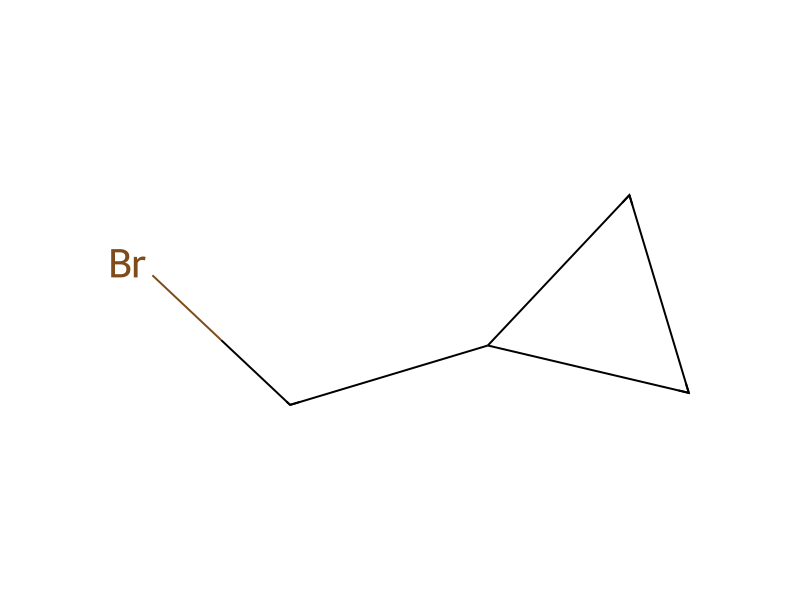
Product 1

Reagents, catalysts & solvents 2


Procedure
4-Bromothiophenol (106.12 g, 561 mmol), cyclopropylmethyl bromide (83.3 g, 617 mmol) and potassium carbonate (85.2 g, 617 mmol) were stirred in DMF (400 mL) overnight. The mixture was diluted with water (1.5 L) and the product extracted into hexanes (2×1 L). The combined organic extracts were dried (MgSO4) and concentrated to give 4-bromophenyl cyclopropylmethyl sulphide as an oil (130.7 g, quantitative). The aforementioned sulphide (10 g, 41 mmol) was dissolved in THF (400 mL) and cooled to −78° C. n-Butyllithium (51 mL of a 1.6 M solution in hexanes) was added dropwise. On completion of addition, the mixture was stirred for a further 15 min before dropwise addition of DMF. The reaction mixture was stirred for 18 h, allowing to warm to room temperature. The reaction was quenched by addition of satd. NH4Cl(aq) followed by water. The product was extracted into diethyl ether (×2) and the combined organic layers were dried (MgSO4) and concentrated. Purification by chromatography on silica eluting with 5 to 10% ethyl acetate in hexane gave the title compound (5.50 g, 70% yield). 1H NMR δ (360 MHz, CDCl3) δ 9.92 (1H, s), 7.76 (2H, d, J=8.4 Hz), 7.38 (2H, d, J=8.2 Hz), 2.97 (2H, d, J=7.0 Hz), 1.14-1.08 (1H, m), 0.67-0.62 (2H, m) 0.35-0.30 (2H, m).
Workup
- extractionthe product extracted into hexanes (2×1 L)
- dry with materialThe combined organic extracts were dried (MgSO4)
- concentrationconcentrated
Sources & evidence
- ORD record
- ord-452a2e044a6b4081a1bebfeed60ca0ae
- Source dataset
- uspto-grants-2012_04
- Patent number
- US08163956B2
Reaction notes
Loading…