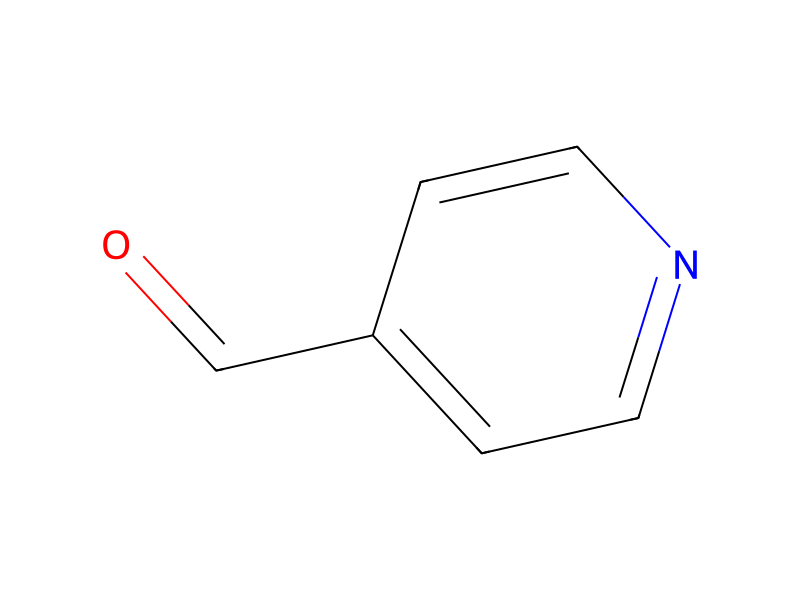
4-Pyridinecarboxaldehyde → HCID 53658794, compound
Reaction equation

[Br-].[CH3:2][O:3][C:4]1[CH:9]=[CH:8][C:7]([O:10][CH3:11])=[CH:6][C:5]=1[CH:12]([CH3:34])[CH2:13][CH2:14][P+](C1C=CC=CC=1)(C1C=CC=CC=1)C1C=CC=CC=1.[N:35]1[CH:40]=[CH:39][C:38]([CH:41]=O)=[CH:37][CH:36]=1.[H-].[Na+]>CS(C)=O.O1CCCC1>[CH3:2][O:3][C:4]1[CH:9]=[CH:8][C:7]([O:10][CH3:11])=[CH:6][C:5]=1[CH:12]([CH3:34])[CH2:13][CH:14]=[CH:41][C:38]1[CH:39]=[CH:40][N:35]=[CH:36][CH:37]=1Participants
Reactant 3


Product 1

Reagents, catalysts & solvents 2


Procedure
A mixture of 3-(2,5-dimethoxyphenyl)butyl triphenylphosphonium bromide (19.0 g., 35.4 mmoles) in dimethylsulfoxide (50 ml.) is added to 4-pyridinecarboxaldehyde (3.79 g., 35.4 mmoles) in tetrahydrofuran (40 ml.). The resulting mixture is then added dropwise to a slurry of 50% sodium hydride (1.87 g., 39 mmoles) in tetrahydrofuran (20 ml.) under a nitrogen atmosphere at 0°-5° C. Following completion of addition, the mixture is stirred for one hour at 0°-5° and then concentrated under reduced pressure. The concentrate is diluted with water (200 ml.) and then acidified with 6 N HCl. The aqueous acid solution is extracted with benzene (4×50 ml.). It is then made basic and extracted with ethyl acetate (3×50 ml.). Evaporation of the combined extracts after drying (MgSO4) affords 4-(2,5-dimethoxyphenyl)-1-(4-pyridyl)-1-pentene.
Workup
- additioncompletion of addition
- concentrationconcentrated under reduced pressure
- additionThe concentrate is diluted with water (200 ml.)
- extractionThe aqueous acid solution is extracted with benzene (4×50 ml.)
- extractionextracted with ethyl acetate (3×50 ml.)
- customEvaporation of the combined extracts
- dry with materialafter drying (MgSO4)
Sources & evidence
- ORD record
- ord-6f4634794f624127b02b476ef932e696
- Source dataset
- uspto-grants-1980_06
- Patent number
- US04206225
Reaction notes
Loading…