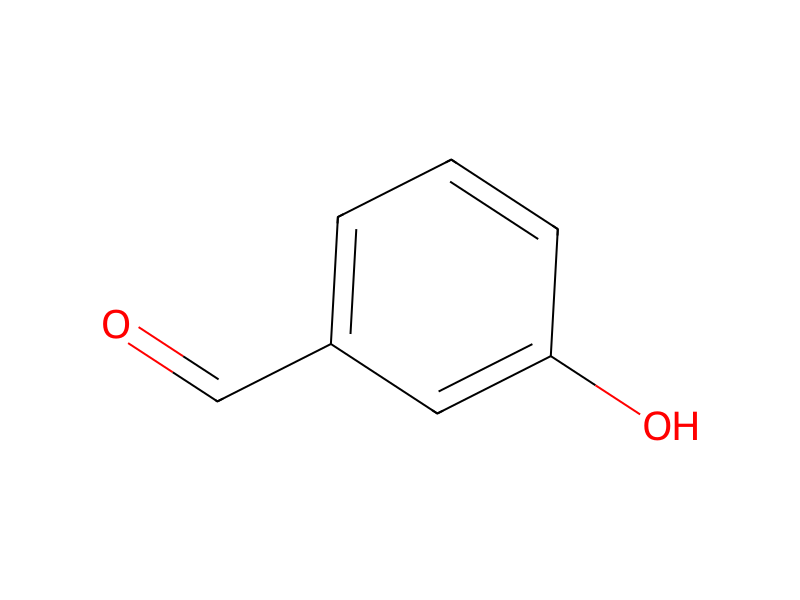
3-Hydroxybenzaldehyde → HCID 10753946, compound
Reaction equation

[OH:1][C:2]1[CH:3]=[C:4]([CH:7]=[CH:8][CH:9]=1)[CH:5]=[O:6].[C:10](=O)([O-])[O-].[K+].[K+].BrC[C:18]1[C:27]2[C:22](=[CH:23][CH:24]=[CH:25][CH:26]=2)[CH:21]=[CH:20][CH:19]=1.O>CN(C=O)C>[CH:26]1[C:27]2[C:22](=[CH:21][CH:20]=[CH:19][CH:18]=2)[CH:23]=[CH:24][C:25]=1[CH2:10][O:1][C:2]1[CH:3]=[C:4]([CH:7]=[CH:8][CH:9]=1)[CH:5]=[O:6]Participants
6
Reactant 4



Product 1

Reagents, catalysts & solvents 1

Procedure
To a solution of 3-hydroxybenzaldehyde (2.44 g; 20 mmol) in DMF (50 ml) were added potassium carbonate (3.04 g; 22 mmol) and bromomethylnaphthalene (4.64 g; 21 mmol), and the resulting mixture was stirred at room temperature for 16 h. The mixture was then poured into water (200 ml) and extracted with ethyl acetate (100 ml). The extract was washed with water, brine, dried over anhydrous magnesium sulfate and concentrated in vacuo. The residue was purified by chromatography (silica gel; methylene chloride-ethyl acetate 19:1) to provide 5.1 g of 3-(2-naphthylmethoxy)benzaldehyde.
Workup
- extractionextracted with ethyl acetate (100 ml)
- washThe extract was washed with water, brine
- dry with materialdried over anhydrous magnesium sulfate
- concentrationconcentrated in vacuo
- customThe residue was purified by chromatography (silica gel; methylene chloride-ethyl acetate 19:1)
Sources & evidence
- ORD record
- ord-7b3f6a347ef246549b4df5d3b68f6591
- Source dataset
- uspto-grants-1994_10
- Patent number
- US05358955
Reaction notes
Loading…