Pyrazole → 1-(2,4,6-Trichlorophenyl)-3-acetylamino-4-pyrazolyl-5-oxo-2pyrazoline
Reaction equation

[Cl:1][C:2]1[CH:7]=[C:6]([Cl:8])[CH:5]=[C:4]([Cl:9])[C:3]=1[N:10]1[C:14](=[O:15])[CH:13](Br)[C:12]([NH:17][C:18](=[O:20])[CH3:19])=[N:11]1.[NH:21]1[CH:25]=[CH:24][CH:23]=[N:22]1>C(OCC)(=O)C>[Cl:1][C:2]1[CH:7]=[C:6]([Cl:8])[CH:5]=[C:4]([Cl:9])[C:3]=1[N:10]1[C:14](=[O:15])[CH:13]([C:25]2[CH:24]=[CH:23][NH:22][N:21]=2)[C:12]([NH:17][C:18](=[O:20])[CH3:19])=[N:11]1Participants
4
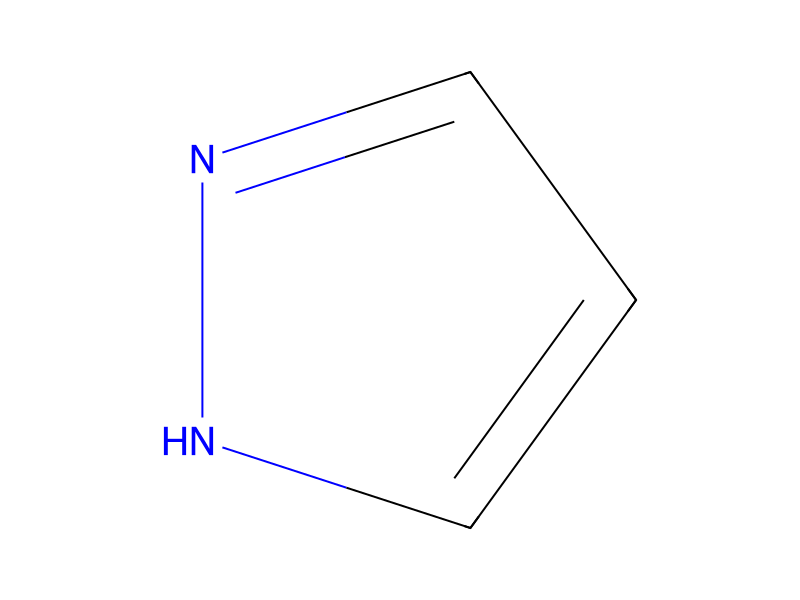



Conditions
- Temperature
- 75 °C
Procedure
Next, 57 g (0.15 mol) of the 1-(2,4,6-trichlorophenyl)-3-acetylamino-4-bromo-5-oxo-2-pyrazoline and 41 g of pyrazole (0.6 mol) were mixed well, then heated for 6 hours at 75° C. in a stream of nitrogen gas to react, after which the reaction mixture was cooled to room temperature. Next the reaction mixture was dissolved in ethyl acetate and the solution was washed with water three times and then dried over anhydrous sodium sulfate. The solvent was distilled off under reduced pressure, acetonitrile was added to the residual oil, and the deposited crystals were filtered to obtain 20.1 g (34.7%) of 1-(2,4,6-trichlorophenyl)-3-acetylamino-4-pyrazolyl-5-oxo-2pyrazoline.
Workup
- customto react
- temperatureafter which the reaction mixture was cooled to room temperature
- washthe solution was washed with water three times
- dry with materialdried over anhydrous sodium sulfate
- distillationThe solvent was distilled off under reduced pressure, acetonitrile
- additionwas added to the residual oil
- filtrationthe deposited crystals were filtered
Sources & evidence
- ORD record
- ord-46a980f9805a405f9046d2dc1a11c967
- Source dataset
- uspto-grants-1990_08
- Patent number
- US04946771
Reaction notes
Loading…