1,1'-Carbonyldiimidazole → 3-Aminoquinuclidine
Reaction equation

ClC1C=CC(C2N(CC(O)=O)C3=NC=CC=C3N=2)=CC=1.C(N1C=CN=C1)(N1C=CN=C1)=O.Cl.Cl.[NH2:35][CH:36]1[CH:41]2[CH2:42][CH2:43][N:38]([CH2:39][CH2:40]2)[CH2:37]1.C[O-].[Na+].[Na]>CO.O1CCCC1>[NH2:35][CH:36]1[CH:41]2[CH2:42][CH2:43][N:38]([CH2:39][CH2:40]2)[CH2:37]1Participants
Reactant 5

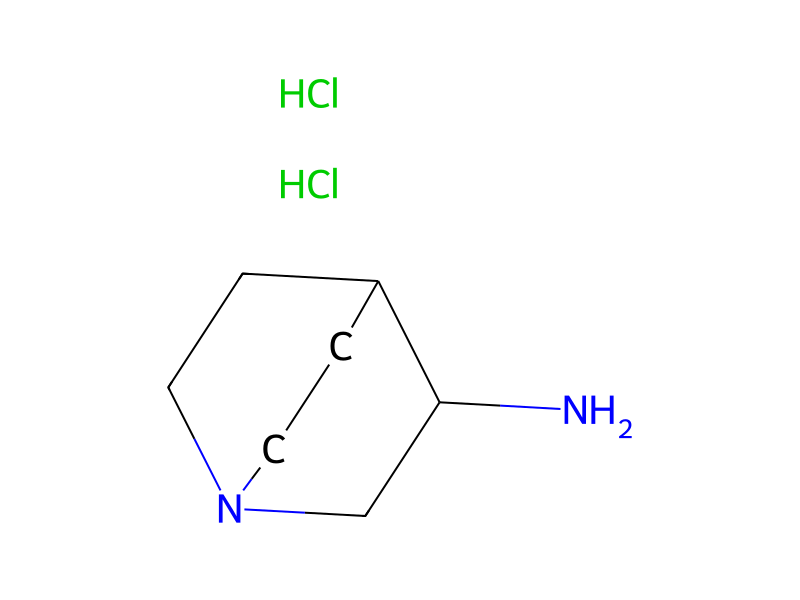



Product 1

Reagents, catalysts & solvents 2


Procedure
A suspension of 2-(4-chlorophenyl)-3H-imidazo[4,5-b]pyridine-3-acetic acid (5.0 g, 0.0174 mole), 1,1'-carbonyldiimidazole (2.82 g, 0.0174 mole) and dry tetrahydrofuran (100 ml) was stirred at room temperature for three hours with nitrogen bubbling through it. 3-Aminoquinuclidine dihydrochloride (20.8 g, 0.104 mole) and sodium methoxide (freshly prepared from 5.28 g of sodium metal in 50 ml of methanol) were stirred at room temperature for one hour. This second suspension was filtered and evaporated to an oil. The oil was extracted into boiling light petroleum ether (1500 ml) and the petroleum ether was then removed under reduced pressure to give 6,6 g of 3-aminoquinuclidine. The 3-aminoquinuclidine was dissolved in tetrahydrofuran (20 ml) and added to the solution containing the product resulting from the first suspension. The reaction mixture was stirred at room temperature under a nitrogen atmosphere overnight.
Workup
- stirringwere stirred at room temperature for one hour
- filtrationThis second suspension was filtered
- customevaporated to an oil
- extractionThe oil was extracted
- customthe petroleum ether was then removed under reduced pressure
Sources & evidence
- ORD record
- ord-3186c2aafa8f47389700f40147f53d4e
- Source dataset
- uspto-grants-1990_08
- Patent number
- US04948800
Reaction notes
Loading…