Trityl chloride → 4-Bromo-1-trityl-1H-imidazole
Reaction equation

C(N(CC)CC)C.[Br:8][C:9]1[N:10]=[CH:11][NH:12][CH:13]=1.[C:14](Cl)([C:27]1[CH:32]=[CH:31][CH:30]=[CH:29][CH:28]=1)([C:21]1[CH:26]=[CH:25][CH:24]=[CH:23][CH:22]=1)[C:15]1[CH:20]=[CH:19][CH:18]=[CH:17][CH:16]=1.C(=O)([O-])O.[Na+]>ClCCl>[Br:8][C:9]1[N:10]=[CH:11][N:12]([C:14]([C:15]2[CH:20]=[CH:19][CH:18]=[CH:17][CH:16]=2)([C:27]2[CH:28]=[CH:29][CH:30]=[CH:31][CH:32]=2)[C:21]2[CH:22]=[CH:23][CH:24]=[CH:25][CH:26]=2)[CH:13]=1Participants
6
Reactant 4
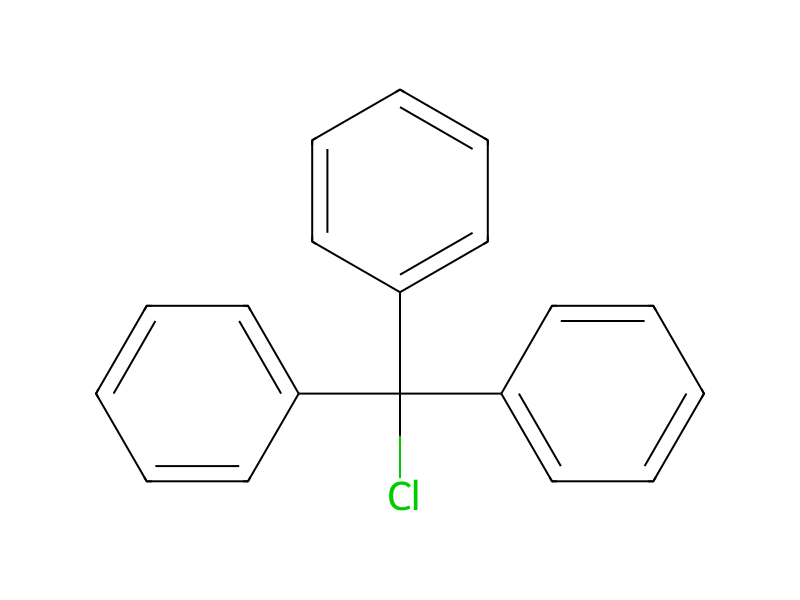



Product 1

Reagents, catalysts & solvents 1

Procedure
0.3787 g of triethylamine is added dropwise over 15 minutes to a solution of 0.500 g of 4-bromoimidazole, 1.043 g of trityl chloride and 25 ml of dichloromethane. The reaction mixture is stirred at room temperature for 11 hours and then poured onto 50 ml of aqueous saturated sodium hydrogencarbonate solution. The mixture is extracted twice with 75 ml of dichloromethane. The combined organic phases are washed with 50 ml of brine, dried over sodium sulphate and concentrated by evaporation. The title compound is obtained as a white solid from the residue by means of flash chromatography (SiO2 60F). Rf=0.38 (1:3 EtOAc-heptane); Rt=5.02.
Workup
- extractionThe mixture is extracted twice with 75 ml of dichloromethane
- washThe combined organic phases are washed with 50 ml of brine
- dry with materialdried over sodium sulphate
- concentrationconcentrated by evaporation
Sources & evidence
- ORD record
- ord-fa6d94626a7448739eafc68baf9ded07
- Source dataset
- uspto-grants-2010_09
- Patent number
- US07790715B2
Reaction notes
Loading…