Trityl chloride → 4-Trityloxy-but-2-en-1-ol
Reaction equation

[C:1](Cl)([C:14]1[CH:19]=[CH:18][CH:17]=[CH:16][CH:15]=1)([C:8]1[CH:13]=[CH:12][CH:11]=[CH:10][CH:9]=1)[C:2]1[CH:7]=[CH:6][CH:5]=[CH:4][CH:3]=1.CCN(CC)CC.[CH2:28]([OH:33])/[CH:29]=[CH:30]\[CH2:31][OH:32].CCCCCC>CN(C1C=CN=CC=1)C.C(Cl)Cl.O>[C:1]([O:32][CH2:31][CH:30]=[CH:29][CH2:28][OH:33])([C:14]1[CH:19]=[CH:18][CH:17]=[CH:16][CH:15]=1)([C:8]1[CH:13]=[CH:12][CH:11]=[CH:10][CH:9]=1)[C:2]1[CH:7]=[CH:6][CH:5]=[CH:4][CH:3]=1Participants
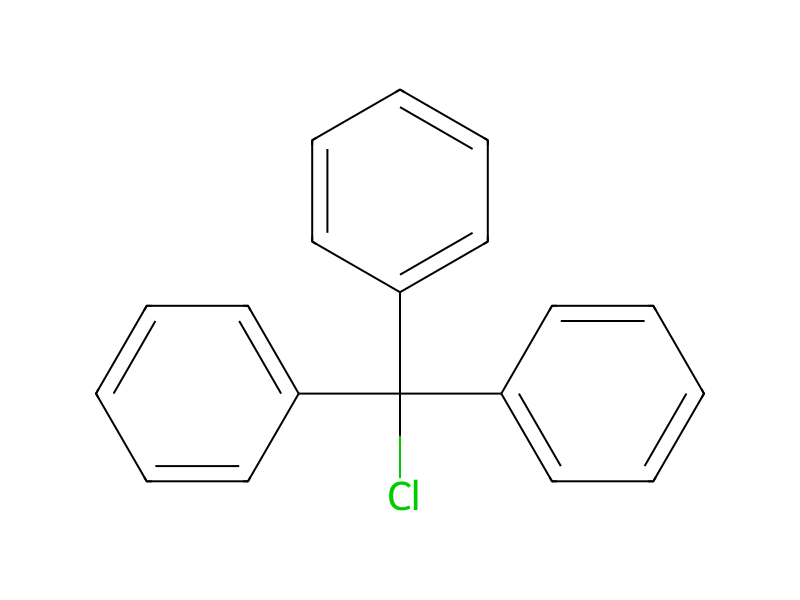







Procedure
Trityl chloride (557 mg; 2 mmol) Et3N (0.306 ml; 2.2 mmol) and DMAP (10 mg; 0.08 mmol) were added to an emulsion of cis-2-buten-1,4-diol (1.76 g; 20 mmol) in DCM (10 ml). The mixture was stirred at room temperature under atmosphere of nitrogen for 24 hours. After such period of time the complete disappearance of trityl chloride was observed by TLC (EtOAC/Hexane 50:50). DCM (20 ml) and water (10 ml) were added to the mixture. The phases were separated and the organic layer was washed with water (10 ml) and brine (10 ml). The solvent was dried over MgSO4 and evaporated under reduced pressure affording a residue (white oil) which was purified by flash chromatography using Hexane/EtOAc 70:30→40:60 as gradient which gave the title product as a colourless oil (563 mg, 81%).
Workup
- customThe phases were separated
- washthe organic layer was washed with water (10 ml) and brine (10 ml)
- dry with materialThe solvent was dried over MgSO4
- customevaporated under reduced pressure
- customaffording a residue (white oil) which
- customwas purified by flash chromatography
Sources & evidence
- ORD record
- ord-b7815ae917054dc8a24d52e954c671db
- Source dataset
- uspto-grants-2010_09
- Patent number
- US07795270B2
Reaction notes
Loading…