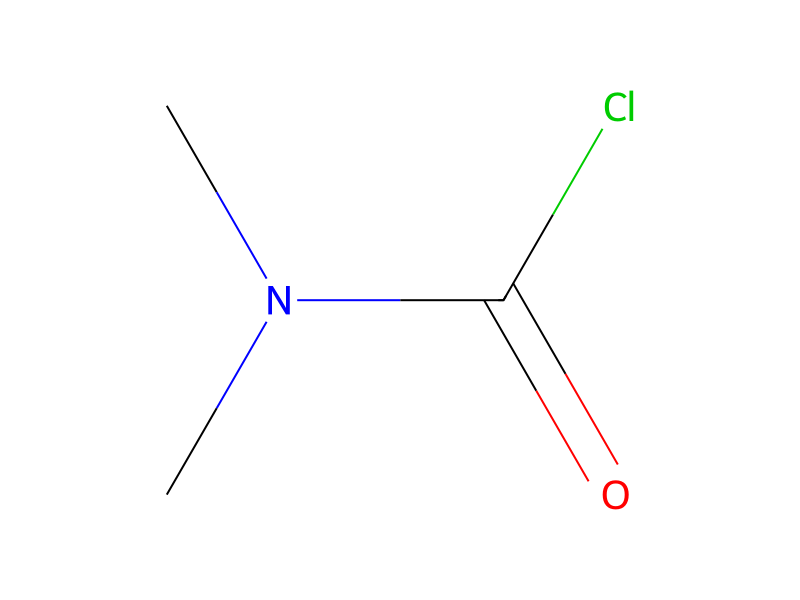
Dimethylcarbamoyl Chloride → 3-Bromopyridine-2-carbonitrile
Reaction equation

C[Si]([C:5]#[N:6])(C)C.[Br:7][C:8]1[CH:9]=[N+:10]([O-])[CH:11]=[CH:12][CH:13]=1.CN(C)C(Cl)=O.C([O-])([O-])=O.[K+].[K+]>C(Cl)Cl>[Br:7][C:8]1[C:9]([C:5]#[N:6])=[N:10][CH:11]=[CH:12][CH:13]=1Participants
6




Procedure
Trimethylsilylcyanide (10 g, 0.1 mol, 1.25 eq) were added to a solution of 3-brom-pyridine-N-oxide (80 mmol, 1 eq) in 80 mL of CH2Cl2. After that a solution of dimethylcarbamoylchloride (10.8 g, 0.1 mol, 1.25 eq). dissolved in 20 mL of dry CH2Cl2 was added drop-wise to the stirred solution. The mixture was stirred overnight at r.t. An aqueous solution of K2CO3 (80 mL, 10%) was added and the mixture was stirred for additional 10 min. The organic layer was separated and the aqueous layer was again extracted two times by means of 30 mL of CH2Cl2. The organic phases were combined and dried by means of Na2SO4. The product was used without further purification.
Workup
- additionwas added drop-wise to the stirred solution
- stirringthe mixture was stirred for additional 10 min
- customThe organic layer was separated
- extractionthe aqueous layer was again extracted two times by means of 30 mL of CH2Cl2
- dry with materialdried by means of Na2SO4
- customThe product was used without further purification
Sources & evidence
- ORD record
- ord-f830879d3b5649bebe5432db49c0628a
- Source dataset
- uspto-grants-2010_09
- Patent number
- US07803810B2
Reaction notes
Loading…