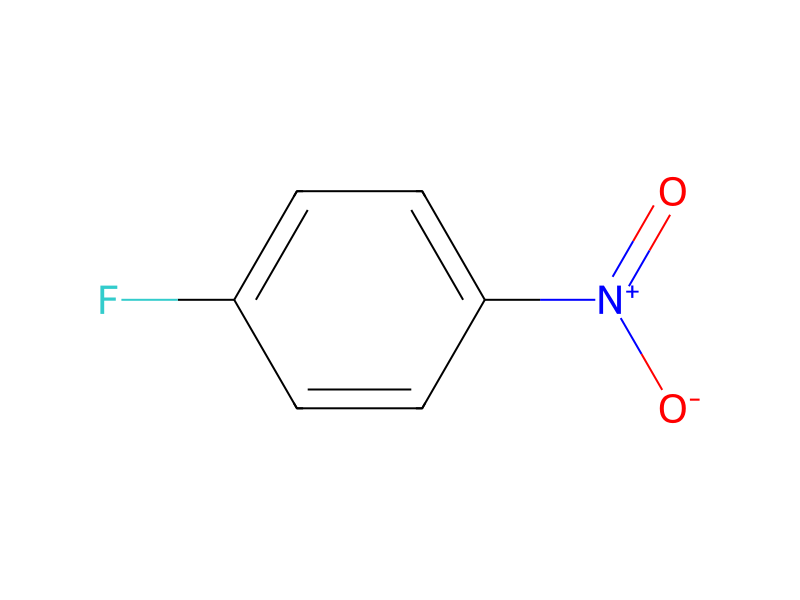
p-Fluoronitrobenzene → 4-nitro-N-prop-2-ynylaniline
Reaction equation

F[C:2]1[CH:7]=[CH:6][C:5]([N+:8]([O-:10])=[O:9])=[CH:4][CH:3]=1.[CH2:11]([NH2:14])[C:12]#[CH:13].[F-].[K+].C(=O)([O-])[O-].[K+].[K+]>CS(C)=O.O>[N+:8]([C:5]1[CH:6]=[CH:7][C:2]([NH:14][CH2:11][C:12]#[CH:13])=[CH:3][CH:4]=1)([O-:10])=[O:9]Participants
7






Procedure
A mixture of 26.6 g (189 mmol) of 4-fluoronitrobenzene, 20.8 g (377 mmol) of propargylamine, 11 g (189 mmol) of potassium fluoride, and 26 g (188 mmol) of potassium carbonate in 600 ml of dimethylsulfoxide is stirred at room temperature under a nitrogen atmosphere for twenty hours. The reaction mixture is poured into 1.5 l of water and stirred at room temperature for two hours. The yellow solid is filtered, rinsed with water, and then isopropyl alcohol. The product is dried in vacuo at 50° C. for two days to give 16.27 g (49%) 4-nitro-N-2-propynylbenzenamine; mp 150°-153° C.
Workup
- stirringstirred at room temperature for two hours
- filtrationThe yellow solid is filtered
- washrinsed with water
- customThe product is dried in vacuo at 50° C. for two days
Sources & evidence
- ORD record
- ord-b491472baee24e0698b0241c97fc805e
- Source dataset
- uspto-grants-1989_08
- Patent number
- US04857530
Reaction notes
Loading…