Hydrochloric Acid → 3-(1,4-dioxo-3,4-dihydrophthalazin-2(1H)-yl)propanoic acid
Reaction equation

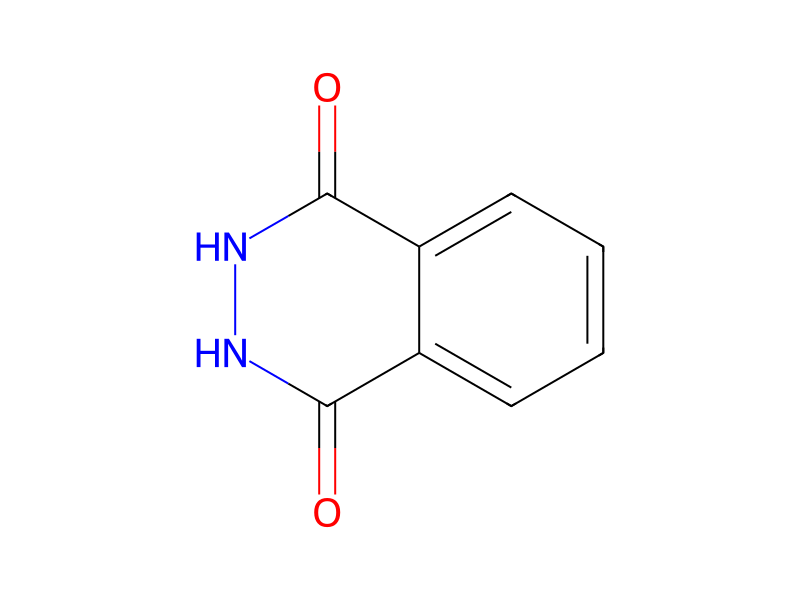
[C:1]1(=[O:12])[C:10]2[C:5](=[CH:6][CH:7]=[CH:8][CH:9]=2)[C:4](=[O:11])[NH:3][NH:2]1.[O-]CC.[Na+].[C:17]([O:21]CC)(=[O:20])[CH:18]=[CH2:19].Cl>C(O)C.[OH-].[Na+]>[C:17]([CH2:18][CH2:19][N:3]1[NH:2][C:1](=[O:12])[C:10]2[C:5](=[CH:6][CH:7]=[CH:8][CH:9]=2)[C:4]1=[O:11])([OH:21])=[O:20]Participants
7
Reactant 4



Product 1

Reagents, catalysts & solvents 2


Procedure
2,3-Dihydrophthalazine-1,4-dione(8.1 g; 0.05 mol) was suspended in 100 ml of absolute ethanol containing a catalytic amount of sodium ethoxide. Ethyl acrylate (5.0 g; 0.05 mol) was added to the suspension and the mixture was reacted under reflux for 42 hours. The hot reaction mixture was filtered and the solvent removed in vacuo. The product thus formed was dissolved in sodium hydroxide (0.07 M; 250 ml) and stirred overnight. The solution was acidified by the addition of hydrogen chloride resulting in the formation of a white crystalline solid. The solid was recrystallized from water to produce the product, 2-(2'-carboxyethyl)-2,3-dihydrophthalazine-1,4-dione.
Workup
- customthe mixture was reacted
- temperatureunder reflux for 42 hours
- filtrationThe hot reaction mixture was filtered
- customthe solvent removed in vacuo
- customThe product thus formed
- customThe solid was recrystallized from water
Sources & evidence
- ORD record
- ord-062da18124974c3ebe7c6aafee82c926
- Source dataset
- uspto-grants-1989_08
- Patent number
- US04861778
Reaction notes
Loading…