Acetic Acid → Sorbitol
Reaction equation

[BH4-].[Na+].[C:3]([OH:6])(=O)[CH3:4].Cl.[OH2:8]>>[O:8]=[CH:4][C@@H:3]([C@H:4]([C@@H:3]([C@@H:4]([CH2:3][OH:6])[OH:8])[OH:6])[OH:8])[OH:6].[CH2:3]([OH:6])[C@@H:4]([C@H:3]([C@@H:4]([C@@H:4]([CH2:3][OH:6])[OH:8])[OH:8])[OH:6])[OH:8]Participants




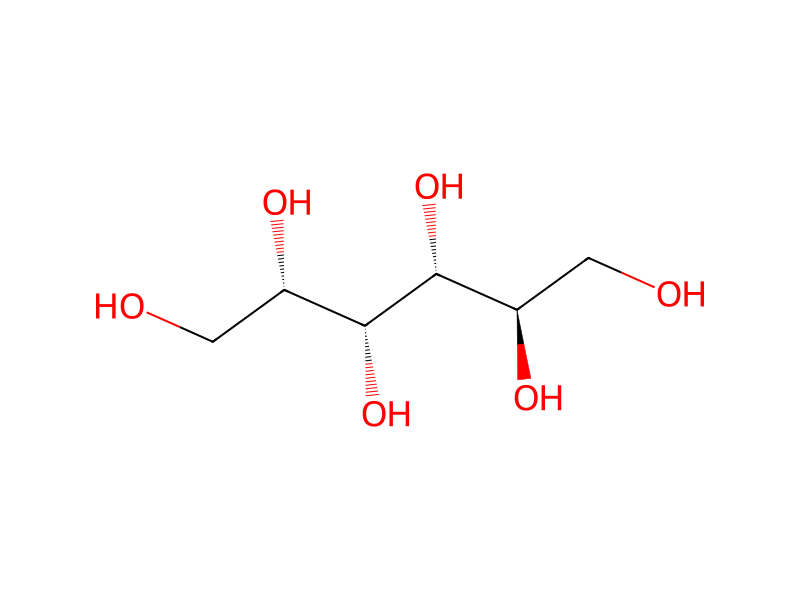

Procedure
To a mixture of 30 μl of the sample, 100 μl of 0.3% sodium borohydride in water was added. After standing for 3 hours at room temperature, 50 μl of 2 M acetic acid was added to the solution to decompose excess reducing reagent. The lyophilized sample was methanolyzed with 0.5 ml of 1.5 N anhydrous methanolic hydrochloric acid at 90° C. for 4 hours. The methanolysate was evaporated in vacuo, and the residue was trimethylsilylated in pyridine with hexamethyldisilazane and trimethylsilyl chloride for 1 hour at room temperature. The column for gas-liquid chromatography was packed with 2% OV-17 on Chromosorb W, 80-100 mesh (0.5×300 cm). The temperature was programmed from 120° C. to 185° C. at the rate of 4° C. increment per min. Using maltose operated in the same manner as standard, the number of glucose of 1, 2, 3, 4 and 5 in each fraction were obtained from the molar ratio of glucose to glucitol. From this, the number of glucose units in the oligosaccharide of 3, 4, 5, 6 and 7 was determined (hereinafter referred to as "FG3, FG4, FG5, FG6 and FG7", respectively).
Workup
- additionwas added
- customThe methanolysate was evaporated in vacuo
- waitthe residue was trimethylsilylated in pyridine with hexamethyldisilazane and trimethylsilyl chloride for 1 hour at room temperature
- customwas programmed from 120° C. to 185° C. at the rate of 4° C. increment per min
Sources & evidence
- ORD record
- ord-c6439c9d96734818a31cdb00c926125c
- Source dataset
- uspto-grants-1986_11
- Patent number
- US04622295
Reaction notes
Loading…