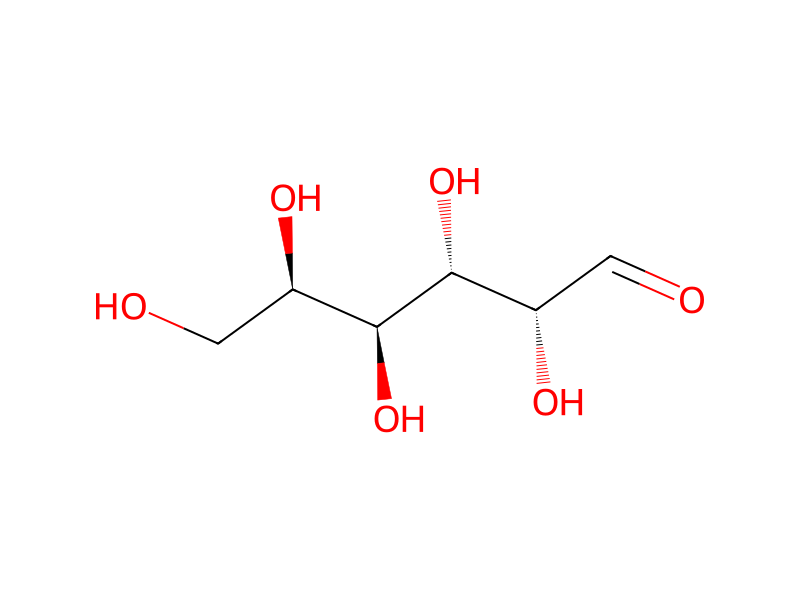
Acetone → (2R,3S,4R,5R)-2,3,4,5,6-pentahydroxyhexanal
Reaction equation

[OH-:1].[Ba+2].[OH-:3].[C:4](=[O:6])=O.F[C:8](F)(F)[C:9]([OH:11])=O.[CH3:14][C:15]([CH3:17])=[O:16].[OH2:18]>[N+]([O-])([O-])=O.[Ag+]>[O:1]=[CH:14][C@H:15]([C@H:17]([C@@H:8]([C@@H:9]([CH2:4][OH:6])[OH:11])[OH:18])[OH:3])[OH:16].[O:1]=[CH:14][C@@H:15]([C@H:17]([C@H:8]([C@@H:9]([CH2:4][OH:6])[OH:11])[OH:18])[OH:3])[OH:16].[O:1]=[CH:14][C@@H:15]([C@H:17]([C@@H:8]([C@@H:9]([CH2:4][OH:6])[OH:11])[OH:18])[OH:3])[OH:16]Participants
Reactant 5





Product 3


Reagents, catalysts & solvents 1

Conditions
- Temperature
- 100 °C
Procedure
In order to determine the composition of the polysaccharide, purified polymer was obtained by diluting broth twenty-fold with distilled water, removing cells by centrifugation at 18,000×g for 30 min., adding sodium chloride to 0.1% volume and precipitating polymer by addition of 3 volumes isopropanol based on the volume of the diluted polymer solution. The polymer precipitate was removed by filtration through a 100 mesh sieve and washed by repulping in 100 milliliters of 70% isopropanol followed by filtration. Material was collected and dried by lyophilization to constant weight (usually 48 hrs.). Polymer was hydrolyzed either with sulfuric acid or trifluoroacetic acid as follows. Ten milligrams of purified polymer was dissolved in 2 milliliters distilled water with rapid stirring. For hydrolysis with sulfuric acid, 2 ml of 4N sulfuric acid were added and the solution was heated in a sealed glass ampoule at 100° C. for 16 hours. The resulting solution was cooled, neutralized with barium hydroxide, and the pH was adjusted to 5-6 with solid carbon dioxide (dry ice). For hydrolysis with trifluoroacetic acid (TFA), 2 ml of 4M TFA were added and the solution heated in a sealed glass ampoule for 4 hours at 120° C. TFA was removed by evaporation under vacuum at room temperature over sodium hydroxide overnight. Traces of TFA were removed by two cycles of dissolving the residue in distilled water and redrying under vacuum. Neutral sugars and uronic acid were tentatively identified by descending paper chromatography on Whatman 3MM paper. The chromatogram was developed using a solvent system composed of butanol, glacial acetic acid, and water in the ratio 6:4:3. Chromatograms were air dried and treated with a solution prepared by mixing 0.1 milliliter of a saturated aqueous solution of silver nitrate into 20 milliliters of acetone. Sugars and uronic acid react with silver nitrate to give gray to black spots depending on concentration. Spots were identified by chromatography of sugar and uronic acid standards. Locations of spots were consistent with a composition of mannose, galactose, glucose, and glucuronic acid. Sugars in the hydrolysate were further identified and quantitated by gas-liquid chromatography of the alditol acetate derivatives [Hisamatsu et al. Carb. Res., 61, 89 (1978)]. With both hydrolysis procedures (i.e. H2SO4 or TFA), a ratio of mannose: galactose: glucose: of about 1.3:1:3.6 was obtained. Organic acid substituents of polymer 105-4 were assayed after their removal by mild acid hydrolysis (2N sulfuric acid, 100° C., 60 min) according to the procedure of Hisamatsu supra. Separation was accomplished by isocratic cation exchange chromatography (Biorad Aminex HPX-87H) using a mobile phase of 0.013N H2SO4, with UV detection at 206 nm. Acetate was the only substituent at about 10 to about 15% by weight of the polymer. Uronic acid was determined by the procedure of Blumenkrantz and Asboe-Hansen, Anal. Biochem. 54, 484 (1973). A range of 10-25% (calculated as glucuronic acid) was found.
Workup
- custompurified polymer
- customwas obtained
- customremoving cells by centrifugation at 18,000×
- additionadding sodium chloride to 0.1% volume
- customprecipitating polymer
- additionby addition of 3 volumes isopropanol
- customThe polymer precipitate was removed by filtration through a 100 mesh sieve
- washwashed
- filtrationfollowed by filtration
- customMaterial was collected
- customdried by lyophilization to constant weight (usually 48 hrs
- dissolutionTen milligrams of purified polymer was dissolved in 2 milliliters
- distillationdistilled water with rapid stirring
- customFor hydrolysis with sulfuric acid, 2 ml of 4N sulfuric acid
- additionwere added
- temperatureThe resulting solution was cooled
- additionwere added
- temperaturethe solution heated in a sealed glass ampoule for 4 hours at 120° C
- customTFA was removed by evaporation under vacuum at room temperature over sodium hydroxide overnight
- customTraces of TFA were removed by two cycles
- dissolutionof dissolving the residue in distilled water
- customredrying under vacuum
- customdried
- additiontreated with a solution
- customprepared
- customto give gray to black spots
- concentrationdepending on concentration
- customWith both hydrolysis procedures (i.e. H2SO4 or TFA)
Sources & evidence
- ORD record
- ord-9f9d1852e5884a34a5278f251e3a0e99
- Source dataset
- uspto-grants-1996_07
- Patent number
- US05532222
Reaction notes
Loading…