Dimethyl Sulfoxide → HCID 285770, compound
Reaction equation

CSC.B.[Cl:5][CH2:6][CH2:7][N:8]([C:12]1[CH:17]=[CH:16][C:15]([CH2:18][CH2:19][C:20](O)=[O:21])=[CH:14][CH:13]=1)[CH2:9][CH2:10][Cl:11].CS(C)=O.C(Cl)(=O)C(Cl)=O.CCN(CC)CC>C1COCC1>[Cl:5][CH2:6][CH2:7][N:8]([C:12]1[CH:13]=[CH:14][C:15]([CH2:18][CH2:19][CH:20]=[O:21])=[CH:16][CH:17]=1)[CH2:9][CH2:10][Cl:11]Participants






Conditions
- Temperature
- 0 °C
Procedure
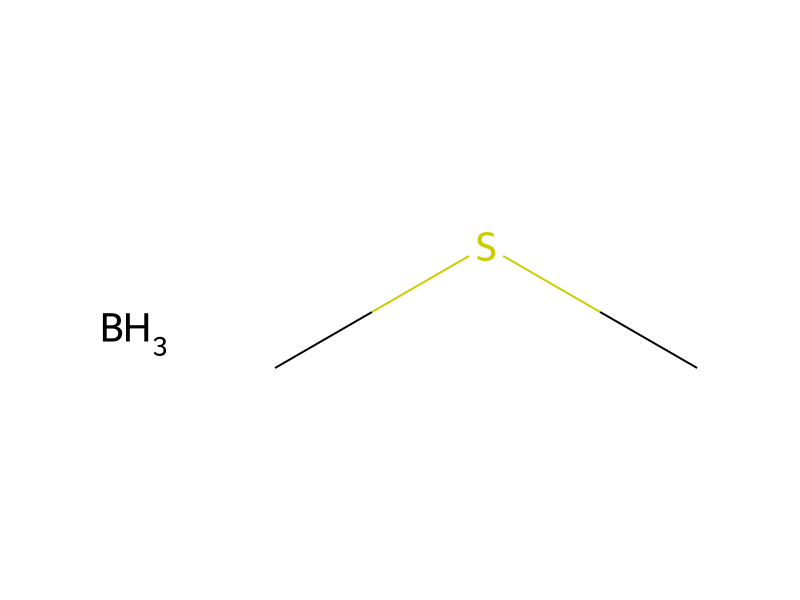
A solution of borane dimethyl sulphide (23 mmol of a 10M solution in THF) was added slowly to a stirred solution of 3-[4-(N,N-bis(2-chloroethyl)amino)phenyl]propanoic acid (VIII, n=2) [Everett, J. L., Roberts, J. J., Ross W. C. J., "Aryl-2-halogenoalkylamines. Part XII. Some carboxylic acid derivatives of N,N-di-2-chloroethylaniline", J. Chem. Soc., 1953 2386-2392] (5.5 g, 19 mmol) in TEF (190 mL) maintained at 0° C. under a N2 atmosphere. After the initial effervescence the solution was stirred for a further 4 h before being quenched with MeOH and concentrated under reduced pressure. The product was partitioned between aqueous NaHCO3 and EtOAc, and the residue from the organic phase was percolated through a pad of SiO2 (EtOAc elution) to give the crude alcohol, which was used without further purification. DMSO (1.15 mol equiv.) was added to a stirred solution of oxalyl chloride (1.1 mol equiv.) in THF (5 mL per mmol of alcohol) maintained at -78° C. under a N2 atmosphere. Stirring was continued for 10 min after which a solution of the above alcohol (1 mol equiv.) in THF (5 mL per mmol of alcohol) was added. Stirring was continued at -78° C. for a further 15 min before Et3N (5.0 mol equiv.) was added and the mixture brought slowly to room temperature. The reaction mixture was partitioned between H2O/EtOAc and the residue from the organic layer was chromatographed on SiO2 and eluted with petroleum ether/EtOAc (3:1) to give pure 3-[4-(N,N-bis(2-chloroethyl)amino]phenyl)propanal (IX, n=2) as an unstable oil (3.4 g, 68% overall yield). 1H NMR (CDCl3) δ 9.80 (t, J1,2 =1.6 Hz, 1 H, CHO), 7.08 (d, J2',3' =8.8 Hz, 2 H, H-2',H-6'), 6.62 (d, J2',3' =8.8 Hz, 2 H, H-3',H-5'), 3.69 (complex t, J=6.5 Hz, 4 H, NCH2CH2Cl), 3.68 (complex t, J=6.5 Hz, 4 H, NCH2CH2Cl), 2.87 (t, J2,3 =7.4 Hz, 2 H, H-3), 2.72 (br dt, J2,3 =7.4 Hz, and J1,2 =1.6 Hz, 2 H, H2), 2.12 (complex m, 4 H, H-2). 13C NMR δ 201.88, 144.56, 129.53, 129.36, 112.28, 53.54, 45.50, 40.48, 27.04. HRMS (EI, 70 eV) : calcd. for C13H17NO3Cl2 273.068720. Found: 273.06881.
Workup
- custombefore being quenched with MeOH
- concentrationconcentrated under reduced pressure
- customThe product was partitioned between aqueous NaHCO3 and EtOAc
- customto give the crude alcohol, which
- customwas used without further purification
- temperaturemaintained at -78° C. under a N2 atmosphere
- stirringStirring
- waitwas continued for 10 min
- stirringStirring
- additionwas added
- custombrought slowly to room temperature
- customThe reaction mixture was partitioned between H2O/EtOAc
- customthe residue from the organic layer was chromatographed on SiO2
- washeluted with petroleum ether/EtOAc (3:1)
- customto give pure
Sources & evidence
- ORD record
- ord-f02f5bd2415343eaa0534ad7f79f41ce
- Source dataset
- uspto-grants-1999_10
- Patent number
- US05968933
Reaction notes
Loading…