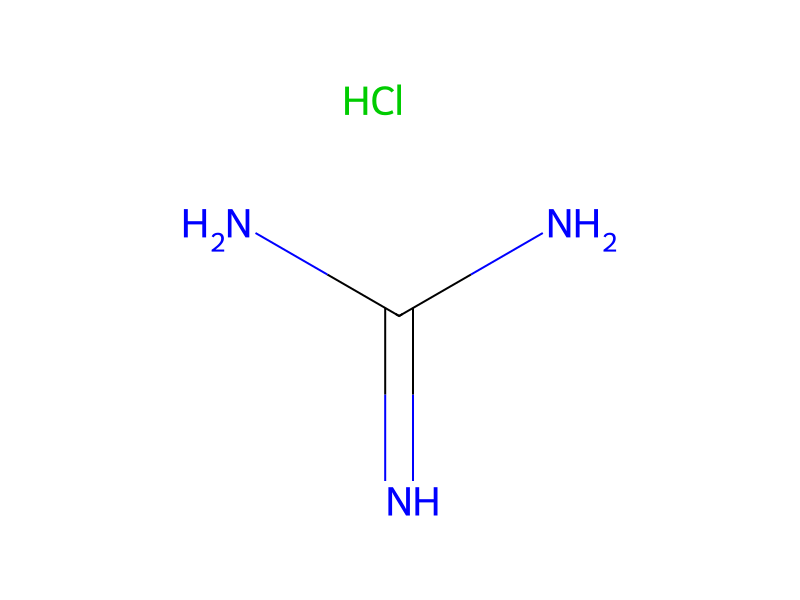
Guanidine Hydrochloride → HCID 178479491, compound
Reaction equation

[ClH:1].[NH2:2][C:3]([NH2:5])=[NH:4].C[O-].[Na+].[C:9]1([C:19]2[CH:20]=[C:21]([CH:37]=[CH:38][CH:39]=2)[C:22](OCC(C)(NS(C(F)(F)F)(=O)=O)C)=[O:23])[C:18]2[C:13](=[CH:14][CH:15]=[CH:16][CH:17]=2)[CH2:12][CH2:11][CH:10]=1.C(OCC)(=O)C>CN(C)C=O.O>[ClH:1].[C:9]1([C:19]2[CH:20]=[C:21]([CH:37]=[CH:38][CH:39]=2)[C:22]([NH:4][C:3]([NH2:5])=[NH:2])=[O:23])[C:18]2[C:13](=[CH:14][CH:15]=[CH:16][CH:17]=2)[CH2:12][CH2:11][CH:10]=1Participants






Procedure
To a solution of guanidine hydrochloride (0.87 g) in N,N-dimethylformamide (5 ml) was added sodium methoxide (1.6 ml, 28% in methanol) under nitrogen atmosphere. After being stirred for 30 minutes at room temperature, to the reaction mixture was added a solution of 2-methyl-2-trifluoromethylsulfonylaminopropyl 3-(3,4-dihydro-1-naphthyl)benzoate (0.59 g) in N,N-dimethylformamide (5 ml). After being stirred for 21 hours at room temperature, the reaction mixture was poured into a mixture of ethyl acetate and water. The organic layer was successively washed with brine and dried over magnesium sulfate. The solvent was evaporated in vacuo, and the residue was dissolved in ethyl acetate and crystallized from slight excess 4N-hydrogen chloride-ethyl acetate. The crystalline was triturated with diethyl ether to give [3-(3,4-dihydro-1-naphthyl)benzoyl]guanidine hydrochloride (0.25 g).
Workup
- stirringAfter being stirred for 21 hours at room temperature
- washThe organic layer was successively washed with brine
- dry with materialdried over magnesium sulfate
- customThe solvent was evaporated in vacuo
- dissolutionthe residue was dissolved in ethyl acetate
- customcrystallized from slight excess 4N-hydrogen chloride-ethyl acetate
- customThe crystalline was triturated with diethyl ether
Sources & evidence
- ORD record
- ord-806d712d9f814aadbe2ed7ee0645cd91
- Source dataset
- uspto-grants-1999_10
- Patent number
- US05968985
Reaction notes
Loading…