Hydrogen Peroxide → (1S,2R)-2-[(Benzyloxy)methyl]cyclopent-3-en-1-ol
Reaction equation

[CH:1]1[CH2:5][CH:4]=[CH:3][CH:2]=1.[Na].Cl[CH2:8][O:9][CH2:10][C:11]1[CH:16]=[CH:15][CH:14]=[CH:13][CH:12]=1.[B]([C@H]1[C@H](C)[C@@H]2C(C)(C)[C@@H](C2)C1)[C@H]1[C@H](C)[C@@H]2C(C)(C)[C@@H](C2)C1.[OH-:38].[Na+].OO>O1CCCC1>[C:11]1([CH2:10][O:9][CH2:8][C@H:2]2[CH:1]=[CH:5][CH2:4][C@@H:3]2[OH:38])[CH:16]=[CH:15][CH:14]=[CH:13][CH:12]=1Participants
Reactant 6

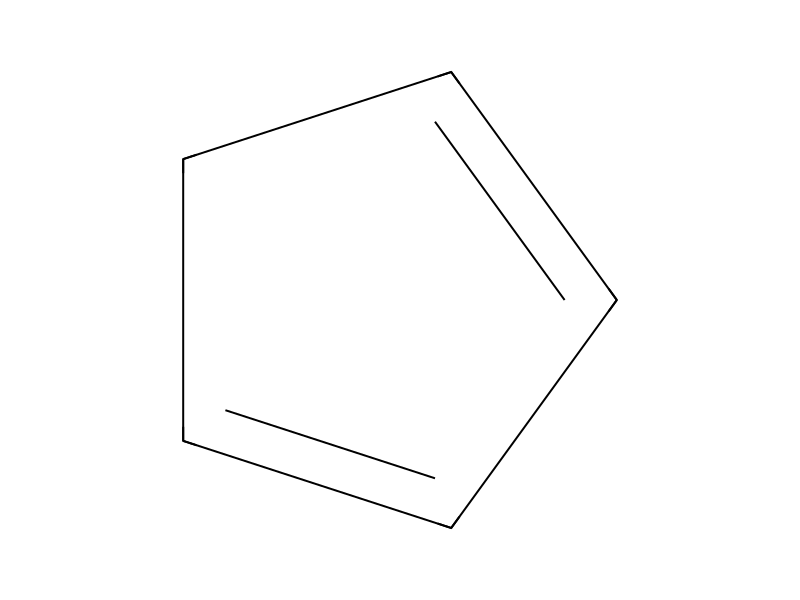




Product 1

Reagents, catalysts & solvents 1

Conditions
- Temperature
- -10 °C
Procedure
The known title compound and the title compounds in sections C and D were prepared by modification of the method of K. Biggadike et al., J. Chem. Soc. Perkin Trans. 1, 549 (1988). Cyclopentadiene (28.68 g, 0.434 mol), maintained at -30°, was added over 1 hour to a stirred mixture of 22.5 g of 40% sodium sand in mineral oil (0.391 g atm) in dry tetrahydrofuran (156 ml) at -10° under nitrogen. After the addition, the mixture was cannulated to an addition funnel at 0° C. and added over 1.3 hours to a stirred solution of benzyl chloromethyl ether (65.2 ml, 0,469 mol) in tetrahydrofuran (130 ml) at -50° under nitrogen. After the addition, the reaction was stirred at -45° for 1.3 hours and then cooled to -60°. Tetrahydrofuran (390 ml) was added followed by the above preparation of (-)-diisopinocampheylborane (136 g, 0,477 mol). The reaction was stirred for 1 hour at -60° C., warmed to -10° C. over 1.5 hours and then stirred for 16 hours at +5°. After concentrating the reaction mixture in vacuo to one half of its original volume, ether (390 ml) was added. The stirred mixture was cooled to 0° and then 3N sodium hydroxide (156 ml, 0,469 mol) was added over 45 minutes keeping the temperature at 0°. Then, 30% hydrogen peroxide (156 ml) was added over 1 hour while maintaining the temperature below 12°. After the addition, the reaction was stirred for 1 hour at 10°, and then the layers were separated. The aqueous layer was washed with ether (300 ml) and all ether layers were combined, washed with aqueous sodium chloride, dried (sodium sulfate), and concentrated in vacuo to a residue. Chromatography of the residue on a column of Merck silica gel (5000 ml) using petroleum ether-ether (2:1) gave a 10 g fraction of impure desired product, a 15.72 g fraction of pure desired product, and a 2.7 g fraction of impure desired product. The 10.0 g and 2.7 g fractions were combined with 4.7 g of impure desired product from several other similar reactions, and the mixture was chromatographed over 1500 ml of Merck silica gel, using petroleum ether-ether (2:1 and then 1:1), to give an additional 8.00 g of pure desired product.
Workup
- additionAfter the addition
- customthe mixture was cannulated to an addition funnel at 0° C.
- additionAfter the addition
- temperaturecooled to -60°
- stirringThe reaction was stirred for 1 hour at -60° C.
- stirringstirred for 16 hours at +5°
- concentrationAfter concentrating the reaction mixture in vacuo to one half of its original volume, ether (390 ml)
- additionwas added
- temperatureThe stirred mixture was cooled to 0°
- customat 0°
- temperaturewhile maintaining the temperature below 12°
- additionAfter the addition
- stirringthe reaction was stirred for 1 hour at 10°
- customthe layers were separated
- washThe aqueous layer was washed with ether (300 ml)
- washwashed with aqueous sodium chloride
- dry with materialdried (sodium sulfate)
- concentrationconcentrated in vacuo to a residue
Sources & evidence
- ORD record
- ord-cec6d4f89d354400bc02e2f252fffd80
- Source dataset
- uspto-grants-1994_08
- Patent number
- US05340816
Reaction notes
Loading…