Sodium Sulfite → HCID 86688388, compound
Reaction equation

[CH:1]12[O:12][CH:4]([CH:5]([S:7]([O:10][CH3:11])(=[O:9])=[O:8])[CH2:6]1)[CH:3]=[CH:2]2.ClC1C=CC=C(C(OO)=[O:21])C=1.S([O-])([O-])=O.[Na+].[Na+]>C(Cl)Cl>[O:21]1[C:3]2[CH:4]3[O:12][CH:1]([CH2:6][CH:5]3[S:7]([O:10][CH3:11])(=[O:8])=[O:9])[C:2]1=2Participants
Reactant 3
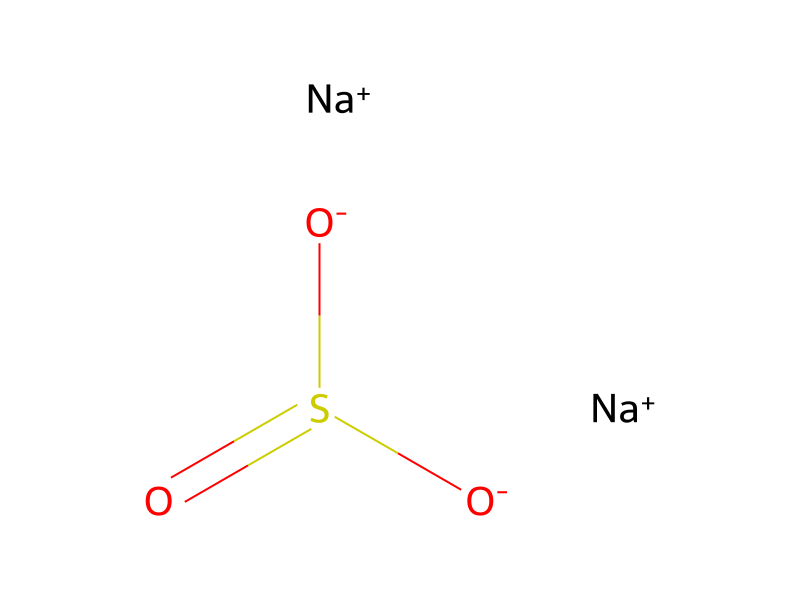


Product 1

Reagents, catalysts & solvents 1

Procedure
To a four-necked flask having a capacity of 1000 mL and equipped with a stirrer, a dropping funnel, and a thermometer, 22.0 g of methyl 7-oxabicyclo[2.2.1]hept-2-ene-5-sulfonate and 450 g of methylene chloride were sequentially added, and the resultant mixture was cooled to 4° C. 22.9 g (0.17 mol) of m-chloroperbenzoic acid was slowly added to the flask under stirring so as to attain a temperature of 10° C. or lower. The resultant mixture was stirred at 5 to 7° C. for 4 hours, and then 100 g of saturated aqueous sodium sulfite solution was added to the mixture, followed by stirring for 30 minutes. The mixture was allowed to stand for liquid-liquid separation, and then washing was carried out thrice with 100 g of saturated aqueous sodium hydrogencarbonate solution. The resultant organic layer was concentrated under reduced pressure, to thereby obtain 20.2 g of methyl 2,3-epoxy-7-oxabicyclo[2.2.1]hept-2-ene-5-sulfonate.
Workup
- customTo a four-necked flask having
- customa capacity of 1000 mL and equipped with a stirrer, a dropping funnel
- customa temperature of 10° C.
- stirringby stirring for 30 minutes
- customto stand for liquid-liquid separation
- washwashing
- concentrationThe resultant organic layer was concentrated under reduced pressure
Sources & evidence
- ORD record
- ord-92e140ecffe14b5697dc5345357b4bee
- Source dataset
- uspto-grants-2015_10
- Patent number
- US09152042B2
Reaction notes
Loading…