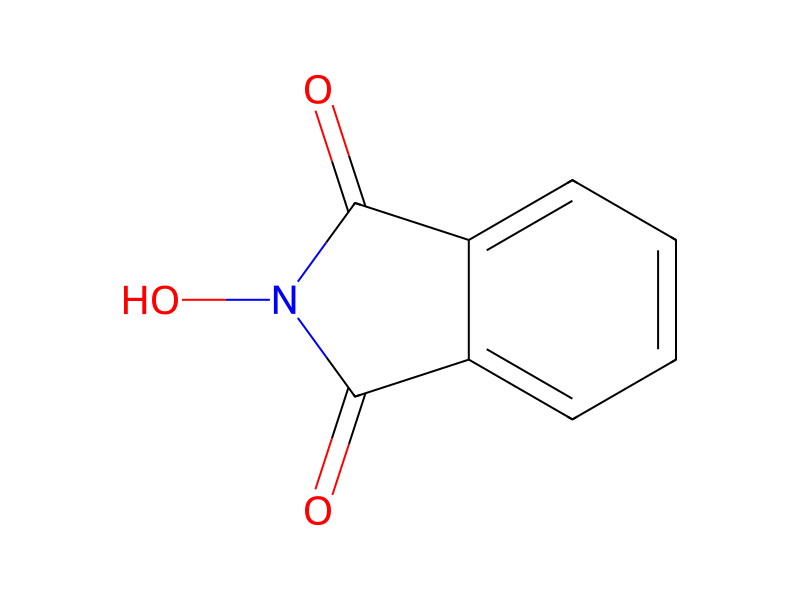
N-Hydroxyphthalimide → HCID 10691182, compound
Reaction equation

CCOC(/N=N/C(OCC)=O)=O.Cl.[CH2:14]([O:21][C:22]([N:24]1[CH2:29][CH2:28][CH2:27][CH:26]([O:30][NH2:31])[CH2:25]1)=[O:23])[C:15]1[CH:20]=[CH:19][CH:18]=[CH:17][CH:16]=1.ON1[C:37](=[O:38])[C:36]2=[CH:39][CH:40]=[CH:41][CH:42]=[C:35]2[C:34]1=[O:43].C1(P(C2C=CC=CC=2)C2C=CC=CC=2)C=CC=CC=1>O1CCCC1>[CH2:14]([O:21][C:22]([N:24]1[CH2:29][CH2:28][CH2:27][CH:26]([O:30][N:31]2[C:37](=[O:38])[C:36]3=[CH:39][CH:40]=[CH:41][CH:42]=[C:35]3[C:34]2=[O:43])[CH2:25]1)=[O:23])[C:15]1[CH:20]=[CH:19][CH:18]=[CH:17][CH:16]=1Participants
6





Procedure
10.05 g of diethylazodicarboxylate were added at 25° C. over 30 minutes to a solution of 10.8 g of the product of Step A, 8.24 g of N-hydroxyphthalimide and 13.25 g of triphenylphosphine in 225 ml of tetrahydrofuran and the mixture was stirred for 4 hours. Then, the solvent was evaporated under reduced pressure and the residue was chromatographed on silica (eluant: ethyl acetate-hexane 1-1) to obtain 13 g of the expected product in the form of 2 diastereoisomers.
Workup
- customThen, the solvent was evaporated under reduced pressure
- customthe residue was chromatographed on silica (eluant: ethyl acetate-hexane 1-1)
Sources & evidence
- ORD record
- ord-60eba32d9bac472b97286660f3c4a6db
- Source dataset
- uspto-grants-1995_08
- Patent number
- US05444051
Reaction notes
Loading…