Hydrochloric Acid → Methanone, 1,3-phenylenebis[phenyl-
Reaction equation

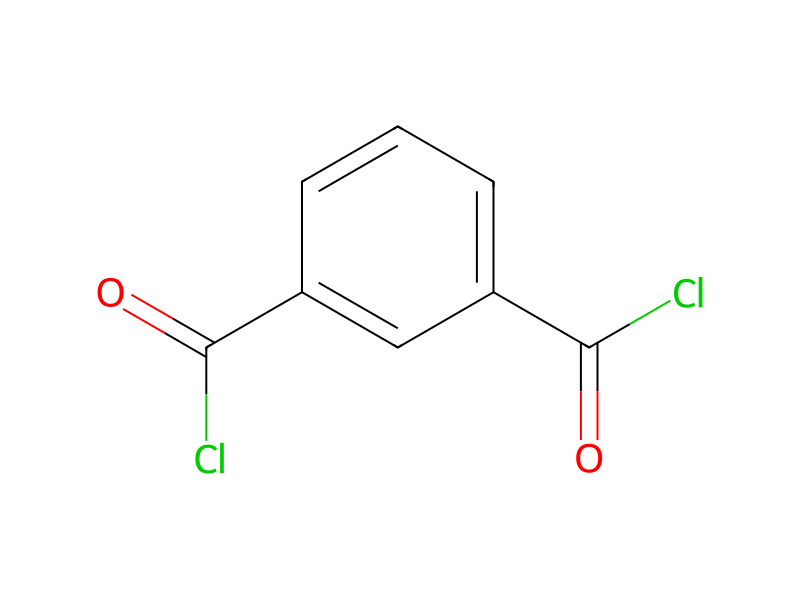
[C:1](Cl)(=[O:11])[C:2]1[CH:10]=[CH:9][CH:8]=[C:4]([C:5](Cl)=[O:6])[CH:3]=1.[C:13]1([Mg]Cl)[CH:18]=[CH:17][CH:16]=[CH:15][CH:14]=1.Cl>C1COCC1>[C:1]([C:2]1[CH:10]=[CH:9][CH:8]=[C:4]([C:5](=[O:6])[C:2]2[CH:10]=[CH:9][CH:8]=[CH:4][CH:3]=2)[CH:3]=1)(=[O:11])[C:13]1[CH:18]=[CH:17][CH:16]=[CH:15][CH:14]=1Participants
5
Reactant 3


Product 1

Reagents, catalysts & solvents 1

Procedure
According to the general mode of operation described above, 203 g (1 mole) of isophthaloyl dichloride in 500 ml of THF is reacted with 274 g (2 moles) of phenyl magnesium chloride. The subsequent hydrolysis is effected with the aid of a dilute hydrochloric acid solution. By cooling, the diketone crystalises. 1,3-dibenzoyl-benzene is obtained in a yield of 75%. The product is recrystallised from ethanol. White crystals are obtained, the melting point of which is 100° C., which corresponds to the formula: ##STR5##
Workup
- customThe subsequent hydrolysis
- temperatureBy cooling
- customthe diketone crystalises
Sources & evidence
- ORD record
- ord-e781d1b704eb45caab59f85632e961d4
- Source dataset
- uspto-grants-1989_05
- Patent number
- US04827044
Reaction notes
Loading…