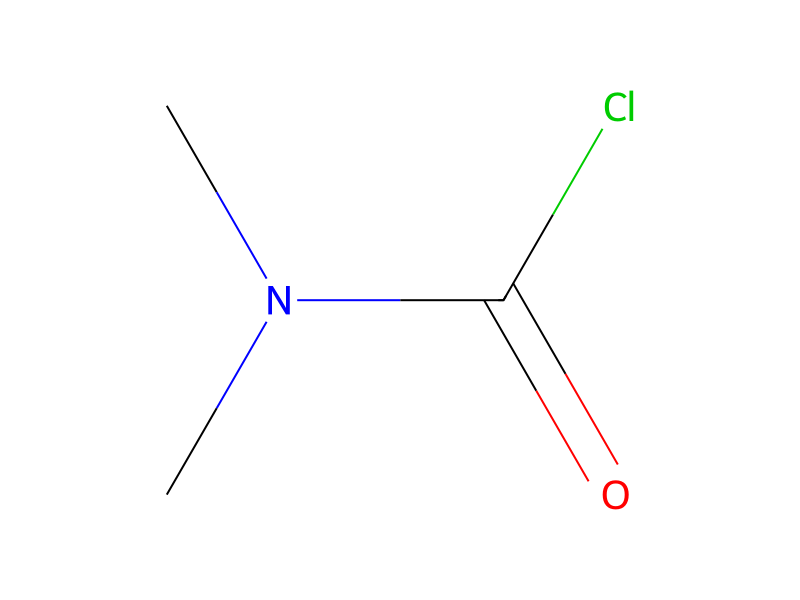
Dimethylcarbamoyl Chloride → HCID 20309760, compound
Reaction equation

[N:1]1[CH:6]=[CH:5][C:4]([C:7]2[N:11]=[C:10]([C:12]3[CH:17]=[CH:16][N:15]=[CH:14][CH:13]=3)[NH:9][N:8]=2)=[CH:3][CH:2]=1.[H-].[Na+].[CH3:20][N:21]([CH3:25])[C:22](Cl)=[O:23]>O1CCCC1>[CH3:20][N:21]([CH3:25])[C:22]([N:8]1[C:7]([C:4]2[CH:5]=[CH:6][N:1]=[CH:2][CH:3]=2)=[N:11][C:10]([C:12]2[CH:17]=[CH:16][N:15]=[CH:14][CH:13]=2)=[N:9]1)=[O:23]Participants
5
Reactant 3


Product 1

Reagents, catalysts & solvents 1

Procedure
To 2.13 g. (0.01 mole) of 3,5-di(4-pyridyl)-1,2,4-triazole in 200 ml. of tetrahydrofuran is added 57% sodium hydride in mineral oil (0.42 g., 0.01 moles). The reaction mixture is heated at reflux for 1 hour, cooled and a solution of dimethylcarbamoyl chloride (1 g., 0.01 mole) in 10 ml. of tetrahydrofuran is added dropwise. The reaction mixture is heated at reflux for 4 hours, cooled, filtered and concentrated to an oil which solidifies. After recrystallization from benzene 1.2 g. of 1-dimethylcarbamoyl-3,5-di(4-pyridyl)-1,2,4-triazole melting at 140°-141.5° C. is obtained.
Workup
- temperatureThe reaction mixture is heated
- temperatureat reflux for 1 hour
- temperaturecooled
- temperatureThe reaction mixture is heated
- temperatureat reflux for 4 hours
- temperaturecooled
- filtrationfiltered
- concentrationconcentrated to an oil which
- customAfter recrystallization from benzene 1.2 g
Sources & evidence
- ORD record
- ord-24c2ace7f5074118b469c7a1db4ffd43
- Source dataset
- uspto-grants-1978_09
- Patent number
- US04111944
Reaction notes
Loading…