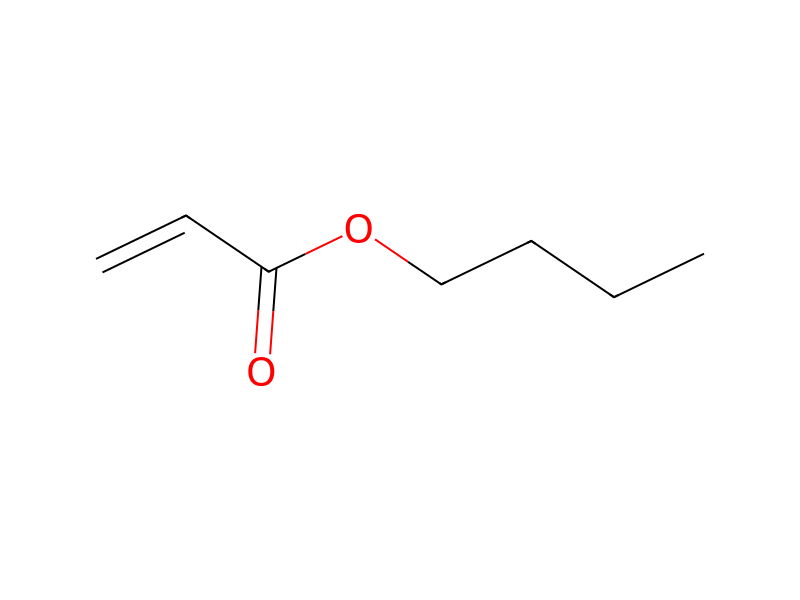
1-Butanol → Butyl Acrylate
Reaction equation

[CH2:1]([O:3][C:4](=[O:7])[CH:5]=[CH2:6])[CH3:2].[CH2:8](O)[CH2:9]CC.C(OC(=O)C=C)C.C(O)C>C1(C=CC(O)=CC=1)O.[C-]#N.[K+]>[C:4]([O:3][CH2:1][CH2:2][CH2:8][CH3:9])(=[O:7])[CH:5]=[CH2:6]Participants
6
Reactant 3



Product 1
Reagents, catalysts & solvents 2


Procedure
500 g of ethylacrylate (5 mole), 92.5 g of n-butanol (1.25 mole) and 0.148 g of hydroquinone (250 ppm) are added to a 1 liter round-bottomed flask. By conducting air through by way of a 1 m vigreux column, the azeotrope is dehydrated. After cooling of the contents of the flask to 60° to 70° C., 6 g of potassium cyanide (1%) are added, and the ethylacrylate/ethanol-azeotrope is distilled-off at 77° C. at the head of the column. After 4 to 5 hours, the trans-esterification is completed. After cooling down of the flask, the potassium cyanide is filtered off and the filter residue is washed out with a little ethyl acrylate. The filtrate is processed by fractional distillation. 155 g of n-butyl acrylate = 97% are obtained.
Workup
- temperatureAfter cooling of the contents of the flask to 60° to 70° C.
- customis distilled-off at 77° C. at the head of the column
- temperatureAfter cooling down of the flask
- filtrationthe potassium cyanide is filtered off
- washthe filter residue is washed out with a little ethyl acrylate
- distillationThe filtrate is processed by fractional distillation
Sources & evidence
- ORD record
- ord-919396cb483844da9272a4fc4e26a910
- Source dataset
- uspto-grants-1978_09
- Patent number
- US04117238
Reaction notes
Loading…