1-Bromo-3-chloropropane → 1-(3-Chloropropyl)indoline
Reaction equation

Br[CH2:2][CH2:3][CH2:4][Cl:5].[NH:6]1[C:14]2[C:9](=[CH:10][CH:11]=[CH:12][CH:13]=2)[CH2:8][CH2:7]1.CCN(CC)CC>O1CCOCC1>[Cl:5][CH2:4][CH2:3][CH2:2][N:6]1[C:14]2[C:9](=[CH:10][CH:11]=[CH:12][CH:13]=2)[CH2:8][CH2:7]1Participants
Reactant 3


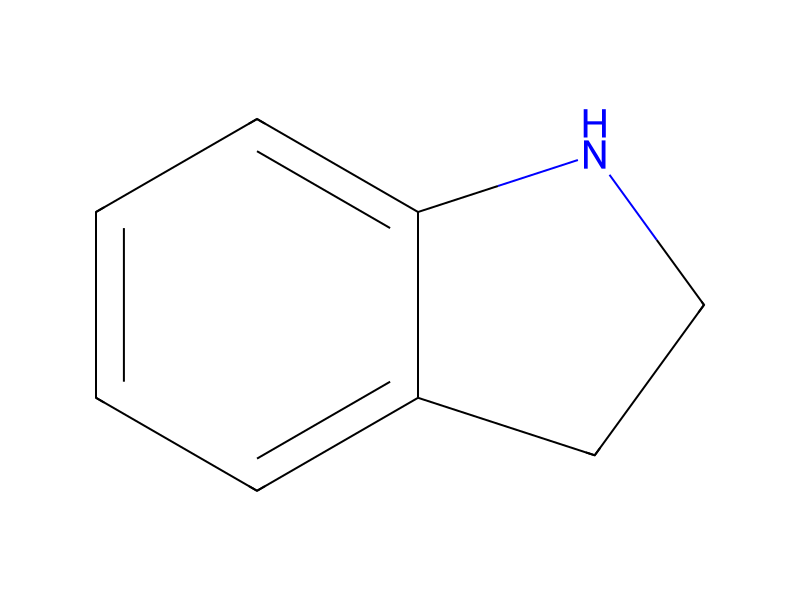
Product 1

Reagents, catalysts & solvents 1

Conditions
- Temperature
- 70 °C
Procedure
To a solution of 1-bromo-3-chloropropane (1.98 g, 12.6 mmol) and indoline (500 mg, 4.20 mmol) in 1,4-dioxane (6.0 mL) was added Et3N (2.12 g, 21.0 mmol) at 20° C. The reaction mixture was then stirred for 15 h at 70° C. The reaction mixture was cooled to 20° C. and quenched by addition of H2O. The product was extracted with Et2O. The organic solution was then washed with H2O and brine, dried over MgSO4, filtered and concentrated in vacuo. 1-(3-Chloro-1-propyl)indoline (373 mg, 45%) was isolated by flash chromatography on a silica gel column by elution with EtOAc/Hexanes a pale yellow oil. 1H NMR (CDCl3, 300 MHz) δ2.07 (qu, 2H, J=6.2 Hz), 2.97 (t, 2H, J=8.2 Hz), 3.24 (t, 2H, J=6.6 Hz), 3.35 (t, 2H, J=8.3 Hz), 3.68 (t, 2H, J=6.2 Hz), 6.50-6.56 (m, 1H), 6.66 (t, 1H, J=6.6 Hz), 7.04-7.10 (m, 2H) ppm.
Workup
- temperatureThe reaction mixture was cooled to 20° C.
- customquenched by addition of H2O
- extractionThe product was extracted with Et2O
- washThe organic solution was then washed with H2O and brine
- dry with materialdried over MgSO4
- filtrationfiltered
- concentrationconcentrated in vacuo
Sources & evidence
- ORD record
- ord-ce9610e188ae45d48093dfe362596894
- Source dataset
- uspto-grants-2007_06
- Patent number
- USRE039679E1
Reaction notes
Loading…