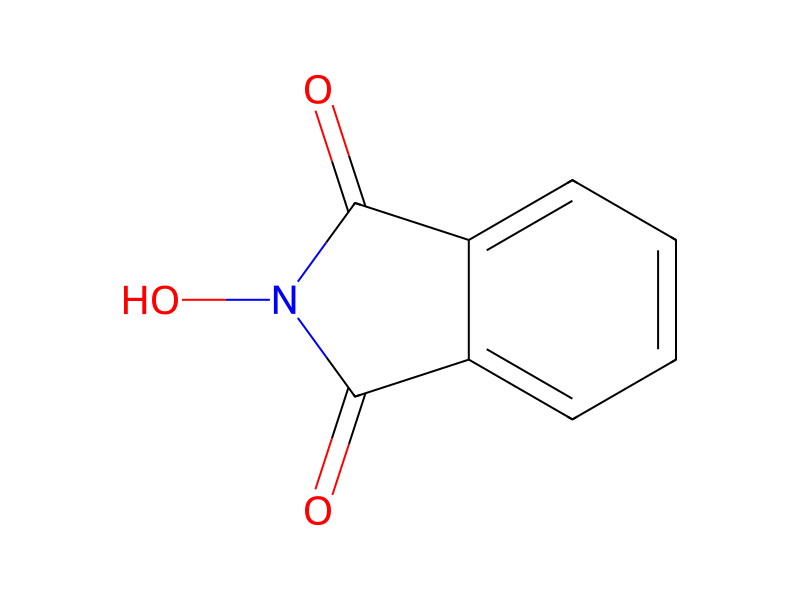
N-Hydroxyphthalimide → HCID 23353087, compound
Reaction equation

[OH:1][N:2]1[C:6](=[O:7])[C:5]2=[CH:8][CH:9]=[CH:10][CH:11]=[C:4]2[C:3]1=[O:12].C1(P(C2C=CC=CC=2)C2C=CC=CC=2)C=CC=CC=1.O[CH2:33][CH2:34][CH2:35][C:36]#[C:37][C:38]1[CH:43]=[CH:42][C:41]([F:44])=[CH:40][CH:39]=1.N(C(OCC)=O)=NC(OCC)=O>O1CCCC1>[F:44][C:41]1[CH:42]=[CH:43][C:38]([C:37]#[C:36][CH2:35][CH2:34][CH2:33][O:1][N:2]2[C:3](=[O:12])[C:4]3=[CH:11][CH:10]=[CH:9][CH:8]=[C:5]3[C:6]2=[O:7])=[CH:39][CH:40]=1Participants





Procedure
33.4 g (0.205 mol) of N-hydroxyphthalimide and 53.8 g (0.205 mol) of triphenylphosphine were added to a solution of 33.1 g (0.186 mol) of 5-hydroxy-1-(4-fluorophenyl)-1-pentyne in 430 ml of dry tetrahydrofuran. 35.7 g (0.205 mol) of diethyl azodicarboxylate were then added dropwise in the course of 2.5 hours with temperature control (max. 40° C.). Stirring was carried out overnight at room temperature, the mixture was evaporated down under reduced pressure and the residue was taken up with 300 ml of dichloromethane. The solution was washed twice with sodium carbonate solution and once with saturated sodium chloride solution. After drying and evaporating down, the crude product was purified by chromatography over silica gel. The eluents used were initially dichloromethane/n-hexane and subsequently pure dichloromethane. Yield: 82%; mp.: 85°-88° C. 250-MHz-1H-NMR (in DMSO-d6): δ[ppm]=1.9-2.1 (m, 2H); 2.68 (t, 2H); 4.342 (t, 2H); 7.18 (t, 2H); 7.4-7.6 (m, 2H); 7.85 (s, 4H).
Workup
- customthe mixture was evaporated down under reduced pressure
- washThe solution was washed twice with sodium carbonate solution and once with saturated sodium chloride solution
- customAfter drying
- customevaporating down
- customthe crude product was purified by chromatography over silica gel
Sources & evidence
- ORD record
- ord-bae56c8b8afb463e99e4ecdf278dcb62
- Source dataset
- uspto-grants-1995_01
- Patent number
- US05378677
Reaction notes
Loading…