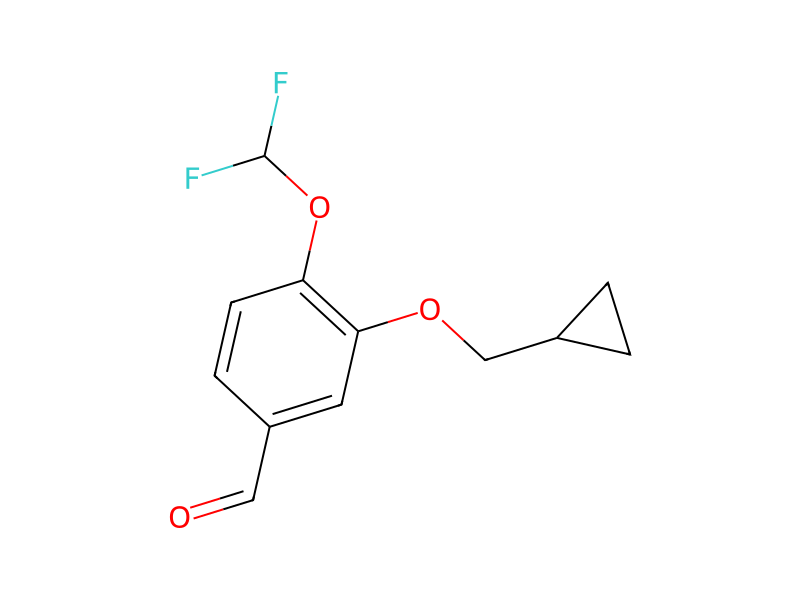
Water → 3-(Cyclopropylmethoxy)-4-(difluoromethoxy)benzaldehyde
Reaction equation

[F:1][CH:2]([F:13])[O:3][C:4]1[CH:11]=[CH:10][C:7]([CH:8]=[O:9])=[CH:6][C:5]=1[OH:12].C(=O)([O-])[O-].[K+].[K+].Br[CH2:21][CH:22]1[CH2:24][CH2:23]1.O>CN(C=O)C>[CH:22]1([CH2:21][O:12][C:5]2[CH:6]=[C:7]([CH:10]=[CH:11][C:4]=2[O:3][CH:2]([F:13])[F:1])[CH:8]=[O:9])[CH2:24][CH2:23]1Participants
6




Procedure
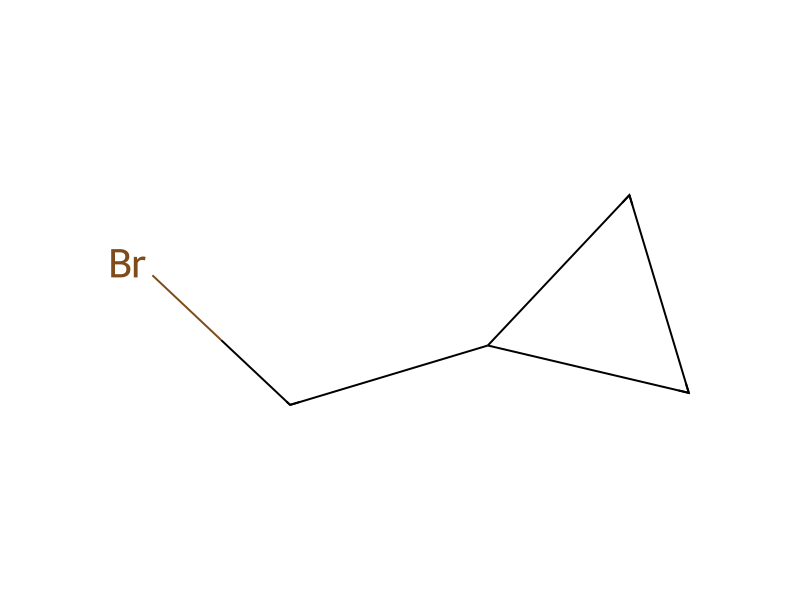
To a solution of 4-(difluoromethoxy)-3-hydroxybenzaldehyde (18.4 g, 98 mmol) in DMF (200 ml), potassium carbonate (29.7 g, 215 mmol) and KI (16.3 g, 98 mmol) were added followed by (bromomethyl)cyclopropane (14.28 ml, 148 mmol), and the resulting suspension was stirred at RT for 24 hours. The mixture was poured into water (800 ml) and extracted with diethyl ether (3×300 ml); the combined organic layers were dried over Na2SO4 and the solvent was removed under vacuum affording 3-(cyclopropylmethoxy)-4-(difluoromethoxy)benzaldehyde (22.5 g, 93 mmol, 94.8% yield, MS/ESI+ 243.1 [MH]+). This product was used without purification.
Workup
- extractionextracted with diethyl ether (3×300 ml)
- dry with materialthe combined organic layers were dried over Na2SO4
- customthe solvent was removed under vacuum
Sources & evidence
- ORD record
- ord-12bef06fb7554cf5a56f500db5336aad
- Source dataset
- uspto-grants-2016_02
- Patent number
- US09265768B2
Reaction notes
Loading…