Hydrochloric Acid → 2-(4-chlorophenyl)-2-(4-nitrophenyl)acetonitrile
Reaction equation

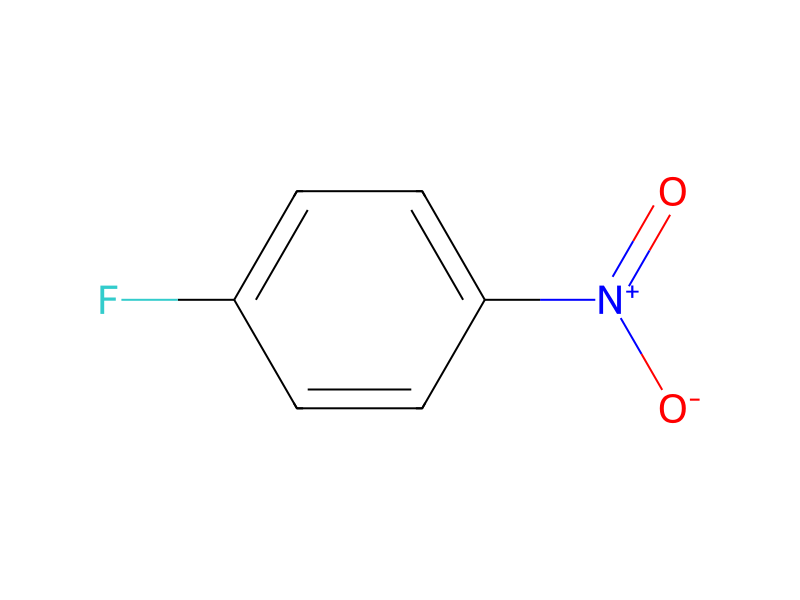
[Cl:1][C:2]1[CH:10]=[CH:9][C:5]([CH2:6][C:7]#[N:8])=[CH:4][CH:3]=1.CC(C)([O-])C.[K+].F[C:18]1[CH:23]=[CH:22][C:21]([N+:24]([O-:26])=[O:25])=[CH:20][CH:19]=1.Cl>C1COCC1.O.C(OCC)(=O)C>[Cl:1][C:2]1[CH:10]=[CH:9][C:5]([CH:6]([C:18]2[CH:23]=[CH:22][C:21]([N+:24]([O-:26])=[O:25])=[CH:20][CH:19]=2)[C:7]#[N:8])=[CH:4][CH:3]=1Participants
8
Reactant 4



Product 1

Reagents, catalysts & solvents 3



Procedure
To a solution of 4-chlorobenzylcyanide (5.909 g, 38.979 mmol, 1.1 equip) in THF (100 mL) was added potassium t-butoxide (9.941 g, 88.589 mmol, 2.5 equip) and the solution was stirred for 10 minutes. 4-Fluoronitrobenzene (5.000 g, 35.435 mmol, 1 equip) was added and the reaction mixture stirred at room temperature overnight. The resulting mixture was acidified to pH 7 with 1N HCl, ethyl acetate and water were added, and the layers were separated. The aqueous layer was extracted 1× with ethyl acetate, and the organic layers were combined, dried (Na2SO4), and concentrated. The residue was purified by MPLC using an ethyl acetate-heptane gradient to yield 2-(4-chlorophenyl)-2-(4-nitrophenyl)acetonitrile as an orange-yellow solid.
Workup
- stirringthe reaction mixture stirred at room temperature overnight
- additionwere added
- customthe layers were separated
- extractionThe aqueous layer was extracted 1× with ethyl acetate
- dry with materialdried (Na2SO4)
- concentrationconcentrated
- customThe residue was purified by MPLC
Sources & evidence
- ORD record
- ord-a05826e0951642559a5502aebdee409d
- Source dataset
- uspto-grants-2016_02
- Patent number
- US09266835B2
Reaction notes
Loading…