Guanidine Hydrochloride → Pyrimidine, 2,4-diamino-5-phenyl-
Reaction equation

[C:1]([C:3]([C:8]1[CH:13]=[CH:12][CH:11]=[CH:10][CH:9]=1)=[CH:4]N(C)C)#[N:2].Cl.[NH2:15][C:16]([NH2:18])=[NH:17].C(=O)([O-])[O-].[K+].[K+].NC1N=CN=C(N)C=1C1C=CC=CC=1>CN(C)C=O>[NH2:17][C:16]1[N:18]=[C:1]([NH2:2])[C:3]([C:8]2[CH:13]=[CH:12][CH:11]=[CH:10][CH:9]=2)=[CH:4][N:15]=1Participants
6
Reactant 4



Product 1

Reagents, catalysts & solvents 1

Procedure
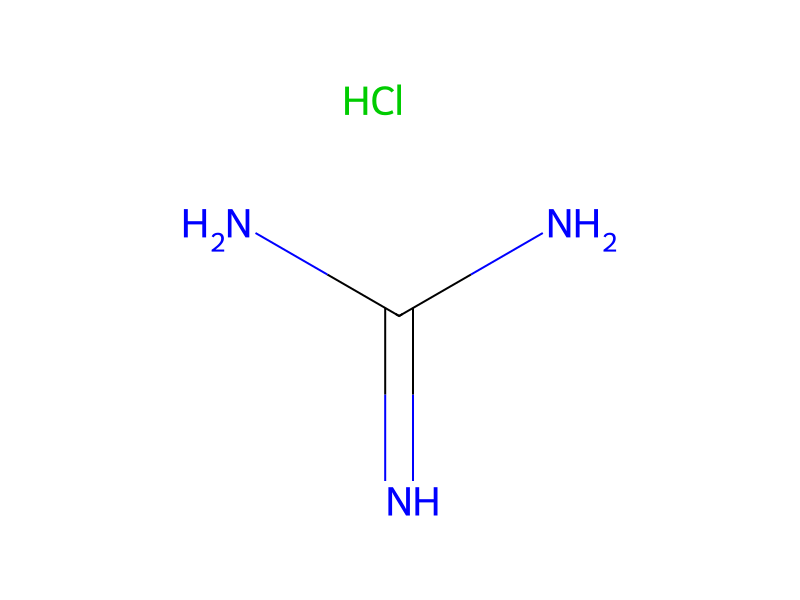
This compound was prepared in a manner analogous to that of Example 2, Step E, using 4.9 grams (0.031 mole) of 1-cyano-1-phenyl-2-(N,N-dimethylamino)ethene, 11.8 grams (0.124 mole) of guanidine hydrochloride, and 21.4 grams (0.1 56 mole) of potassium carbonate in N,N-dimethylformamide. The yield of 2,4.-diamino-5-phenylpyrimidine was 0.7 gram; mp 162°-164° C. The NMR spectrum was consistent with the proposed structure.
Workup
- customThis compound was prepared in a manner analogous to that of Example 2, Step E
Sources & evidence
- ORD record
- ord-2f07ad530ebd4cf2ab244702f5e57c7a
- Source dataset
- uspto-grants-1997_05
- Patent number
- US05627189
Reaction notes
Loading…