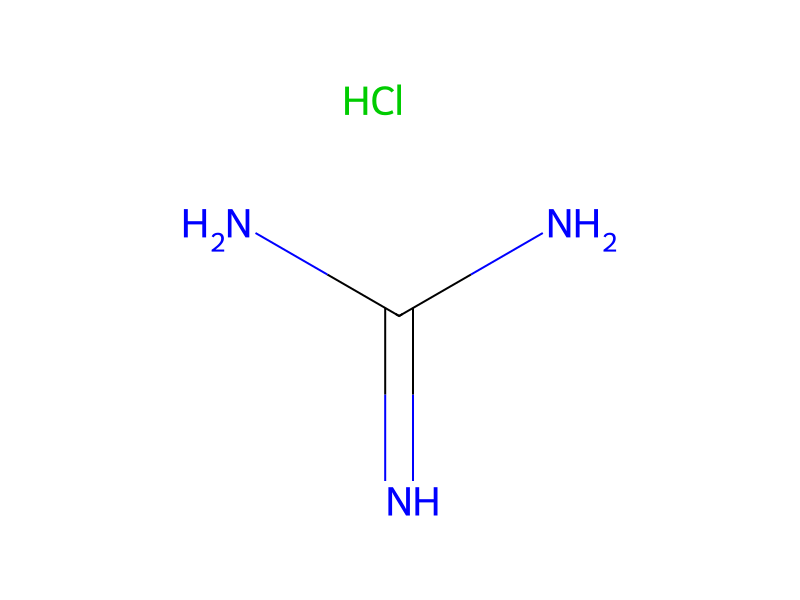
Guanidine Hydrochloride → 2,4,6-Triamino-5-[3-(naphth-1-yl)propyl]pyrimidine
Reaction equation

[O-]CC.[Na+].[Na].Cl.[NH2:7][C:8]([NH2:10])=[NH:9].[C:11]([CH:13]([CH2:16][CH2:17][CH2:18][C:19]1[C:28]2[C:23](=[CH:24][CH:25]=[CH:26][CH:27]=2)[CH:22]=[CH:21][CH:20]=1)[C:14]#[N:15])#[N:12]>C(O)C>[NH2:9][C:8]1[N:10]=[C:14]([NH2:15])[C:13]([CH2:16][CH2:17][CH2:18][C:19]2[C:28]3[C:23](=[CH:24][CH:25]=[CH:26][CH:27]=3)[CH:22]=[CH:21][CH:20]=2)=[C:11]([NH2:12])[N:7]=1Participants





Procedure
A solution of sodium ethoxide, prepared from 0.04 gram (0.002 mole) of sodium metal in 50 mL of ethanol, was stirred, and 0.2 gram (0.002 mole) of guanidine hydrochloride was added in one portion. The reaction mixture was stirred for 15 minutes and filtered to remove a precipitate. The filtrate was stirred, and 0.4 gram (0.002 mole) of 2-cyano-5-(naphth-1-yl)pentanenitrile was added in one portion. Upon completion of addition, the reaction mixture was heated at reflux for about 16 hours. After this time the reaction mixture was concentrated under reduced pressure to a residue. The residue was triturated with warm water, yielding, when dried, 0.4 gram of 2,4,6-triamino-5-[3-(naphth-1-yl)propyl]-pyrimidine, mp 181°-183° C., (dec.). The NMR spectrum was consistent with the proposed structure.
Workup
- stirringThe reaction mixture was stirred for 15 minutes
- filtrationfiltered
- customto remove a precipitate
- stirringThe filtrate was stirred
- additionUpon completion of addition
- temperaturethe reaction mixture was heated
- temperatureat reflux for about 16 hours
- concentrationAfter this time the reaction mixture was concentrated under reduced pressure to a residue
- customThe residue was triturated with warm water
- customyielding
- customwhen dried
Sources & evidence
- ORD record
- ord-ce4f290fcdbf45f5859a056bfb1ed509
- Source dataset
- uspto-grants-1997_05
- Patent number
- US05627189
Reaction notes
Loading…