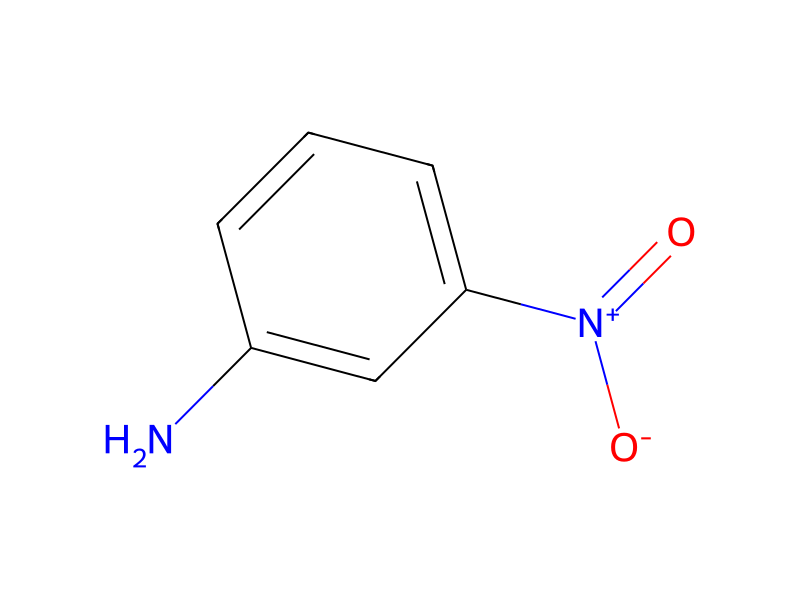
3-Nitroaniline → 4-(3-Nitrophenyl)morpholine
Reaction equation

[N+:1]([C:4]1[CH:5]=[C:6]([CH:8]=[CH:9][CH:10]=1)[NH2:7])([O-:3])=[O:2].Br[CH2:12][CH2:13][O:14][CH2:15][CH2:16]Br.C(N(CC)C(C)C)(C)C>CC(N(C)C)=O.C(Cl)Cl>[N+:1]([C:4]1[CH:5]=[C:6]([N:7]2[CH2:16][CH2:15][O:14][CH2:13][CH2:12]2)[CH:8]=[CH:9][CH:10]=1)([O-:3])=[O:2]Participants
Reactant 3


Product 1

Reagents, catalysts & solvents 2


Conditions
- Temperature
- 120 °C
Procedure
To a solution of 3-nitroaniline (42)(5.52 g, 40.00 mmol) in anhydrous dimethylacetamide (15 ml) was added 2-bromoethylether (7.52 ml, 60.00 mmol) and N,N-diisopropylethylamine (13.94 ml, 80.0 mmol). The mixture was then heated to 120° C. for 6 hours. After this time the reaction was cooled to room temperature which saw the mixture take the form of a slurry. The slurry was dissolved in CH2Cl2 (80 ml) and washed with 0.2 M HCl (3×30 ml). The organic layer was separated, dried (MgSO4), filtered and concentrated in vacuo to give a brown semi-solid residue that was triturated with Et2O to give the desired product (8.33 g, 79.7%) in suitably clean form to be used without any further purification. m/z (LC-MS, ESP): 209 [M+H]+, R/T=3.46 mins
Workup
- temperatureAfter this time the reaction was cooled to room temperature which
- washwashed with 0.2 M HCl (3×30 ml)
- customThe organic layer was separated
- dry with materialdried (MgSO4)
- filtrationfiltered
- concentrationconcentrated in vacuo
- customto give a brown semi-solid residue that
- customwas triturated with Et2O
Sources & evidence
- ORD record
- ord-f308ab084e7e4581ab6ea97ce1ef1c30
- Source dataset
- uspto-grants-2009_03
- Patent number
- US07504397B2
Reaction notes
Loading…