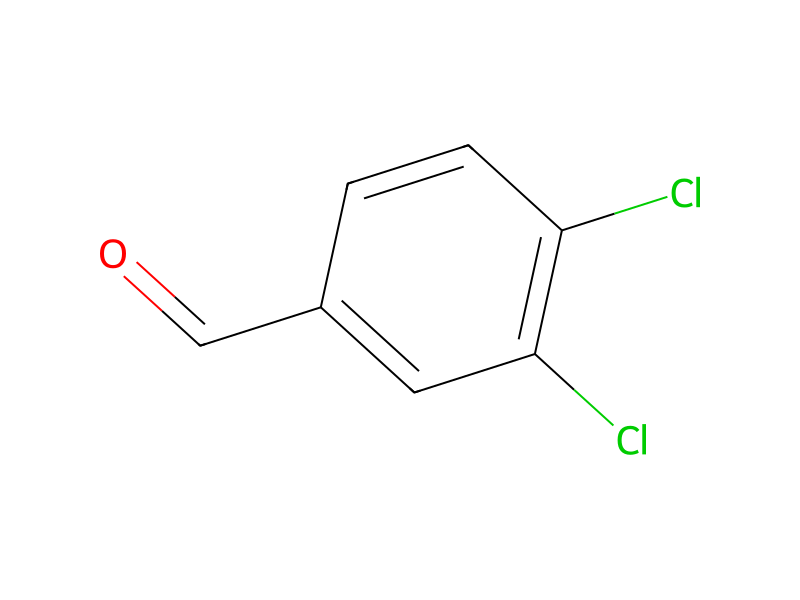
3,4-Dichlorobenzaldehyde → HCID 68828353, compound
Reaction equation

[N:1]1([S:6]([CH2:9][C:10](=[O:12])[CH3:11])(=[O:8])=[O:7])[CH2:5][CH2:4][CH2:3][CH2:2]1.[Cl:13][C:14]1[CH:15]=[C:16]([CH:19]=[CH:20][C:21]=1[Cl:22])[CH:17]=O>C1COCC1.CC(C)[O-].CC(C)[O-].CC(C)[O-].CC(C)[O-].[Ti+4]>[Cl:13][C:14]1[CH:15]=[C:16]([CH:17]=[C:9]([S:6]([N:1]2[CH2:2][CH2:3][CH2:4][CH2:5]2)(=[O:7])=[O:8])[C:10](=[O:12])[CH3:11])[CH:19]=[CH:20][C:21]=1[Cl:22]Participants
Reactant 2

Product 1

Reagents, catalysts & solvents 2


Conditions
- Temperature
- 80 °C
Procedure
Alternatively, the Bignelli reaction was carried out in two steps with higher yields. To 1-(pyrrolidin-1-ylsulfonyl)propan-2-one in THF was added an equivalent amount of 3,4-dichlorobenzaldehyde and a catalytic amount of titanium tetraisopropoxide. The reaction was stirred at 80° C. overnight. Solvent was removed and the residue was purified by silica flash chromatography (0% to 15% ethyl acetate-hexanes) to provide 4-(3,4-dichlorophenyl)-3-(pyrrolidin-1-ylsulfonyl)but-3-en-2-one. The product obtained was dissolved in 1,4-dioxane and one equivalent of 3-methyl-1H-pyrazol-5-amine was added. The reaction was stirred at 80° C. for 24-48 hrs. Solvent was removed and product was obtained after flash chromatography (silica gel, 0% to 40% ethyl acetate-hexanes).
Workup
- customAlternatively, the Bignelli reaction
- customwith higher yields
- customSolvent was removed
- customthe residue was purified by silica flash chromatography (0% to 15% ethyl acetate-hexanes)
Sources & evidence
- ORD record
- ord-9c2886ef1d6d4ad683a8640399023baa
- Source dataset
- uspto-grants-2009_03
- Patent number
- US07507730B2
Reaction notes
Loading…